
Last updated: July 2026
The best Caro-Kann book for most club players is Opening Repertoire: The Caro-Kann by IM Jovanka Houska (Everyman Chess), a complete Black repertoire against every main White system.
For deeper Black preparation, Playing the Caro-Kann by GM Lars Schandorff (Quality Chess) goes furthest into the main lines, while Bologan’s Caro-Kann by GM Victor Bologan (New in Chess) offers a modern, engine-tested alternative.
For White, Squeezing the Caro-Kann: Simple Chess (Chess Stars) is a positional Exchange Variation weapon, A Practical Opening Repertoire for White, Vol. 1 (Thinkers Publishing) covers the English Variation with 2.c4, and Attacking the Caro-Kann (Chess Stars) is a dedicated Advance Variation repertoire. All are available on Forward Chess with free interactive sample chapters.
What Is the Caro-Kann Defence?
The Caro-Kann Defence arises after 1.e4 c6 2.d4 d5. Black’s first move, 1…c6, prepares to challenge White’s central pawn with 2…d5 while keeping the c8 bishop’s diagonal open. This is the key structural difference from the French Defence (1.e4 e6): in the French, the bishop on c8 is often hemmed in by the d5 pawn; in the Caro-Kann, it can become active.
The result is a defence that is solid but not passive. Black fights for the centre immediately, avoids early material concessions, and aims for a sound pawn structure that supports a gradual counterattack.
All Caro-Kann ebooks: Quick Comparison
| Book | Author | Publisher | Year | Color | Best For |
|---|---|---|---|---|---|
| Opening Repertoire: The Caro-Kann | Jovanka Houska | Everyman Chess | 2019 | Black | 1200–2000 |
| The Caro-Kann Revisited | Francesco Rambaldi | Thinkers Publishing | 2020 | Black | 1500–2000 |
| Playing the Caro-Kann | Lars Schandorff | Quality Chess | 2021 | Black | 1600–2200 |
| Bologan’s Caro-Kann | Victor Bologan | New in Chess | 2018 | Black | 2000–2400 |
| Squeezing the Caro-Kann: Simple Chess | Khalifman & Soloviov | Chess Stars | 2022 | White | 1800–2400 |
| A Practical Opening Repertoire for White, Vol. 1 | Alexei Kovalchuk | Thinkers Publishing | 2025 | White | 1400–2000 |
| Attacking the Caro-Kann | Alexey Dreev | Chess Stars | 2015 | White | 2000–2400 |
Rating ranges are editorial estimates based on each book’s target audience and content level; they are not publisher designations.
Why Do Strong Players Choose the Caro-Kann?
The Caro-Kann has been a consistent choice at the highest levels of chess. Anatoly Karpov built much of his opening preparation around it; Tigran Petrosian favoured it for its structural reliability; more recently it has been employed by top players who want a dependable Black answer to 1.e4 without the theoretical demands of the Sicilian.
For club players, the appeal is similar. The Caro-Kann gives Black a sound pawn structure from the start, avoids the sharpest tactical lines, and produces positions where understanding matters as much as memorization. That said, it is not without its own theoretical challenges — the Advance Variation (3.e5), the Panov-Botvinnik Attack (3.exd5 cxd5 4.c4), and the Classical Variation all have significant bodies of theory that serious players need to know.
Which Book Gives Club Players the Best Complete Black Repertoire?
Opening Repertoire: The Caro-Kann by Jovanka Houska (Everyman Chess, 2019)

For players new to the opening and for club players who want a complete, ready-to-use Black system, Houska’s Opening Repertoire: The Caro-Kann is the standard first choice.
What’s Covered
- Classical Variation — 3.Nc3/3.Nd2 dxe4 4.Nxe4, the main club battleground
- Advance Variation — 3.e5, with Black’s counterplay against White’s space
- Exchange and Panov-Botvinnik — 3.exd5 cxd5, both the quiet and the c4 treatments
- Sidelines — efficient methods against White’s tricky move orders
Jovanka Houska (IM, WGM) is a nine-time British Women’s Champion and the 2006 ECF Player of the Year — a player who has used the Caro-Kann seriously at the highest levels of women’s chess for years. This book is a thorough update of her earlier Play the Caro-Kann (2007), and the revision shows: the repertoire is coherent, clearly reasoned, and grounded in genuine over-the-board experience.
What makes this the right first complete repertoire:
- It covers everything. White’s main systems — Classical, Advance, Exchange, Panov-Botvinnik, and sidelines — are all addressed. A player who works through this book emerges with a complete Black system.
- It is calibrated for the practical player. The explanations do not assume deep prior knowledge of the opening; they build from structural ideas outward.
- The author has lived with these positions. Recommendations feel considered rather than compiled.
For most players below 2000, this is the book to own first.
Which Caro-Kann Book Offers the Deepest Intermediate Coverage?
The Caro-Kann Revisited: A Complete Repertoire for Black by Francesco Rambaldi (Thinkers Publishing, 2020)
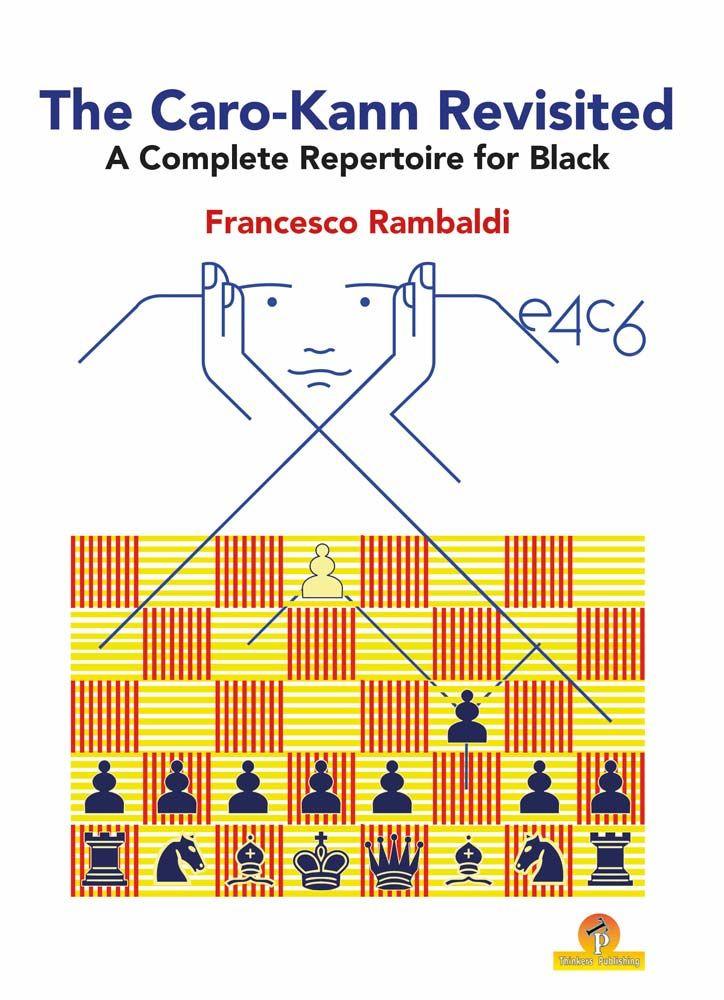
The Caro-Kann Revisited is Francesco Rambaldi’s complete Black repertoire, running to 408 pages and pitched at intermediate level. Rambaldi earned the Grandmaster title at 16 after winning the Wien International Open — one of the youngest GMs at the time.
What’s Covered
- Advance Variation — 3…c5, with heavy coverage of the critical 4.dxc5
- Open Caro-Kann — the main line 4…Nf6 5.Nxf6 exf6
- Two Knights — the reliable 3…Bg4
- Panov, Exchange and Fantasy — 5…Nc6 and 5…e6, the early 2.c4, 4.Bd3, and 3.f3
Where Houska’s book is calibrated for accessibility and practical use at club level, Rambaldi goes deeper. The 408 pages reflect genuine coverage — not padding, but more thorough treatment of the lines that matter at intermediate level, with a GM’s sense of where Black’s real theoretical challenges lie.
This is the natural step up for players who have worked through Houska and want more, or for intermediate players who prefer a denser, more comprehensive approach from the start.
Which Book Provides the Most Complete and Theoretically Demanding Black Preparation?
Playing the Caro-Kann by Lars Schandorff (Quality Chess, 2021)
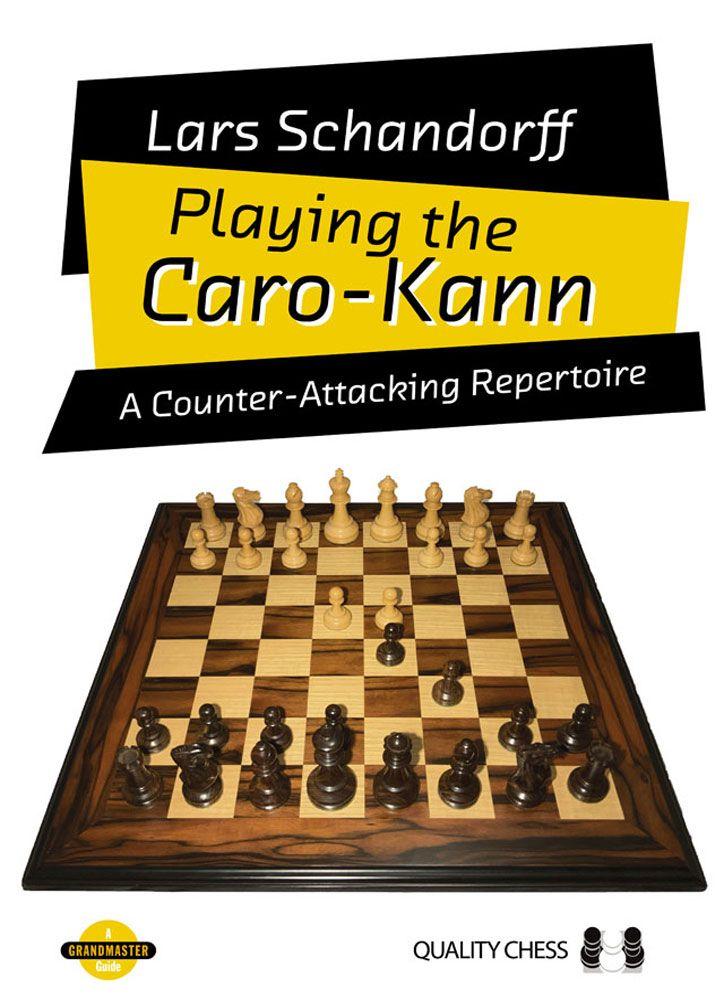
Playing the Caro-Kann (2021) is Lars Schandorff’s completely new Caro-Kann repertoire — not a revision of his earlier Grandmaster Repertoire 7: The Caro-Kann (2010) but a fresh work, described as improving on it “in every way.” Schandorff is a Danish Grandmaster and a recognized openings specialist known for his accurate home preparation.
What’s Covered
- Classical Variation — 4…Nf6 5.Nxf6 exf6, accepting doubled pawns for piece activity
- Advance Variation, Short System — the immediate counterattack 5…c5
- Two options after 6.Be3 — the solid 6…cxd4 and the sharper 6…Qb6
- Illustrative games — annotated to show the positional motifs behind the lines
At 344 pages and intermediate level, this is the most theoretically thorough Black Caro-Kann repertoire in this set. Quality Chess books are built for players who intend to study seriously, and this one is no exception — the analysis goes deep, the recommendations are concrete, and the book rewards repeated study rather than a single read-through.
This is the book for players who want to understand the Caro-Kann thoroughly rather than just survive it. If you are between 1600 and 2200 and prepared to put in the work, Schandorff is one of the most complete single resources available — the other, equally thorough but more modern in approach, is Bologan’s book below.
Which Book Offers a Modern, Engine-Tested Black Repertoire?
Bologan’s Caro-Kann: A Modern Repertoire for Black by Victor Bologan (New in Chess, 2018)

Victor Bologan is a Grandmaster and an experienced opening author, and Bologan’s Caro-Kann: A Modern Repertoire for Black sits alongside Schandorff at the demanding end of the Black repertoires here. The two are best understood as a choice of style rather than a ranking: both are serious, complete repertoires for players ready to study.
What’s Covered
- A complete Black repertoire against all of White’s main systems
- Two options in many lines — typically one that equalises cleanly, one that keeps winning chances
- Strategic and tactical grounding — the motifs behind each structure, not just move orders
Where Schandorff emphasizes deep main lines, Bologan’s repertoire is modern and engine-tested, with a solid, positional orientation — reviewers have praised how modern and up-to-date its coverage is. That solidity comes with an honest caveat, though: the repertoire is memorization-heavy, and a number of its lines ask Black to hold sound but somewhat passive positions rather than play for the initiative. It rewards players who are comfortable defending accurately and who want up-to-date theory.
This is an advanced pick. Like Schandorff, it assumes you will put in the work — players newer to the opening are better served by starting with Houska.
An honest caveat. The repertoire is memorization-heavy, and a number of its lines ask Black to hold sound but somewhat passive positions rather than play for the initiative. It rewards players who are comfortable defending accurately.
What Are the Options for Playing White Against the Caro-Kann?
If you play 1.e4 and want a concrete weapon against the Caro-Kann rather than a sidestep, the books below offer complete White systems — three different ones: the Exchange, the English Variation (2.c4), and the Advance (3.e5). Note that if you would rather learn the Caro-Kann as Black than take up a White weapon against it, Houska above is a more accessible starting point — the books here are for players specifically looking to fight the Caro-Kann as White.
Squeezing the Caro-Kann: Simple Chess by Alexander Khalifman & Sergei Soloviov (Chess Stars, 2022)

What’s Covered
- Exchange Variation — 1.e4 c6 2.d4 d5 3.exd5 cxd5 4.Bd3, the whole book
- Setups with and without h3 — the two structural branches of White’s plan
- The Simple Chess method — control the centre, develop, castle, then act
Squeezing the Caro-Kann: Simple Chess is a positional White repertoire built around the Exchange Variation: 1.e4 c6 2.d4 d5 3.exd5 cxd5 4.Bd3. White exchanges early and plays a long, technical game — exploiting small structural advantages rather than seeking sharp complications. It is pitched at advanced players. Its lead author, Alexander Khalifman, is a Grandmaster and FIDE World Champion (1999).
The Exchange Variation has a reputation for being drawish at the highest levels, but in practical play — especially below 2200 — it creates the kind of patient, positional pressure that many opponents find genuinely difficult to handle.
Read a free sample on Forward Chess
A Practical Opening Repertoire for White, Volume 1: Battling the French & Caro-Kann by FM Alexei Kovalchuk (Thinkers Publishing, 2025)

What’s Covered
- English Variation — 2.c4, continuing 3.cxd5 cxd5 4.exd5 Nf6 5.Qa4
- Black’s alternatives — 2…e6, 2…g6, 2…e5 and the Steiner Variation
- The French Defence — the Exchange Variation, covered in the same volume
The Caro-Kann is Part II of the book. The French takes up Part I, so this is not 336 pages of Caro-Kann.
For intermediate players who want a fighting White system rather than a deeply technical one, FM Alexei Kovalchuk’s A Practical Opening Repertoire for White, Vol. 1 (Thinkers Publishing, 2025) is the most accessible of the three White options here, pitched at intermediate rather than advanced players. The book covers White against both the French and the Caro-Kann; for the Caro-Kann, Kovalchuk recommends the English Variation (2.c4), with particular attention to the 5.Qa4 idea. The approach is a practical, fighting one aimed at intermediate players rather than a deeply theoretical treatment.
This is a different flavor from Squeezing: where Khalifman offers a deeply technical Exchange system for advanced players, Kovalchuk’s English Variation gives intermediate players a fighting system that sidesteps the main theoretical battlegrounds. Worth noting: the book covers both the French and the Caro-Kann; the Caro-Kann section is a portion of the 336-page total.
Scope note. This volume covers White against both the French and the Caro-Kann. The Caro-Kann section is Part II, so it is a portion of the 336-page total, not the whole book.
Attacking the Caro-Kann: A Repertoire for White by Alexey Dreev (Chess Stars, 2015)

What’s Covered
- Advance Variation — 1.e4 c6 2.d4 d5 3.e5, the entire book
- Against 3…c5 — 4.dxc5, the critical test
- Against 3…Bf5 — the main road with 4.Nf3 e6 5.Be2, including the 6.Be3 lines
- Complete games — illustrative games plus an index of variations
The third White option takes on the Caro-Kann with its sharpest and most theoretical try: the Advance Variation, 1.e4 c6 2.d4 d5 3.e5. Alexey Dreev is an elite Grandmaster and a well-known opening theoretician, and Attacking the Caro-Kann is devoted entirely to fighting the Caro-Kann with 3.e5 — the one main White system that neither of the books above covers.
This is the most demanding and most specialized of the three White repertoires: it is aimed at players who specifically want to meet the Caro-Kann head-on in the Advance and are willing to learn concrete, forcing lines. One honest caveat: the book dates from 2015, and the Advance is exactly the kind of sharp, forcing system where engine-driven theory keeps moving — so treat it as a foundation from a strong theoretician rather than the last word, and check its critical lines against current practice.
A note on the date. This book is from 2015, and the Advance Variation is exactly the kind of sharp, forcing system where engine-driven theory keeps moving. Treat it as a foundation from a strong theoretician rather than the last word, and check its critical lines against current practice.
Which Caro-Kann Variations Should Club Players Know?
The Caro-Kann branches early: after 1.e4 c6 2.d4 d5, White has several distinct approaches, each with its own character and theory demands.
Tier 1 — Know in depth:
- Classical Variation (3.Nc3 or 3.Nd2, then 3…dxe4 4.Nxe4) — the most commonly played line at club level. Black develops the light-squared bishop with 4…Bf5 (the other main replies being 4…Nd7 and 4…Nf6) and enters a slightly cramped but solid middlegame. The main battleground for most players.
- Advance Variation (3.e5) — White grabs space immediately and attacks the kingside. Creates a French-like pawn structure but with Black’s light-squared bishop already outside the pawn chain. Fashionable at all levels; requires concrete knowledge of Black’s counterplay with …c5. Dreev’s White repertoire above is devoted entirely to this line.
Tier 2 — Know the key ideas:
- Panov-Botvinnik Attack (3.exd5 cxd5 4.c4) — positions resembling the IQP (isolated queen’s pawn) structures from the Nimzo-Indian or QGD. Dynamic and double-edged; White gets piece activity, Black has a solid structure.
- Exchange Variation (3.exd5 cxd5) — symmetrical pawn structure; White’s advantage lies in the extra tempo. The basis for the Squeezing book above.
- Fantasy Variation (3.f3) — aggressive and underrated at club level. White aims for f4-f5; Black must know the specific antidotes.
Tier 3 — Familiarity is enough:
- Two Knights (2.Nc3 d5 3.Nf3) and other early sideline move orders that avoid the 2.d4 main line — understanding Caro-Kann structure and general principles usually navigates these.
All the major Black repertoire books above — Houska, Rambaldi, Schandorff, and Bologan — cover Tiers 1 and 2 in depth.
How Does the Caro-Kann Compare to Other Defences Against 1.e4?
| Defence | Character | Theory Demands | Structural Result | For Black |
|---|---|---|---|---|
| Caro-Kann (1…c6) | Solid, active | Medium–High | Sound pawn structure; active bishop | Reliable choice for positional players |
| French (1…e6) | Solid, counterattacking | Medium–High | Solid but c8 bishop can be passive | Similar appeal; less bishop problem |
| Sicilian (1…c5) | Dynamic, unbalanced | Very high | Asymmetrical; sharp middlegames | Best winning chances; highest theory demand |
| Scandinavian (1…d5) | Direct, concrete | Low–Medium | Early queen development; practical | Less complex; some theoretical drawbacks |
| Pirc/Modern (1…g6) | Hypermodern | Medium | Flexible; fianchettoed bishop | More passive initially; needs solid nerves |
The Caro-Kann sits between the French and the Sicilian in terms of ambition: more fighting than the French (the bishop is active), less theoretically demanding than the Sicilian (positions are more structural), and more reliable than the Scandinavian at higher levels.
How Should Club Players Study the Caro-Kann?
Recommended Study Path
Step 1: Start with the ideas, not the moves
The Caro-Kann is built on a few structural principles: the fight for d5, the active c8 bishop, queenside counterplay with …c5 in the Advance Variation, and piece coordination in the Classical. Houska’s repertoire builds these ideas up from structural principles rather than assuming them, which makes it a workable starting point even if the opening is new to you.
Step 2: Pick a complete repertoire book and work through it in full
Once you have the ideas, commit to one full repertoire book. Houska for most club players; Schandorff or Bologan if you want maximum depth. Work through the entire book rather than only the lines you expect to face. The Caro-Kann’s main variations branch unpredictably, and gaps tend to appear exactly where you least expect them.
Step 3: Use the Forward Chess interactive board to drill critical positions
The Caro-Kann has positions where specific move order knowledge matters, particularly in the Classical and Advance Variations. Stepping through variations move by move and testing yourself on key positions is far more effective than reading static diagrams for this kind of concrete preparation.
Step 4: Play it, then look up what went wrong
Theoretical knowledge becomes usable repertoire only through practice. Play the Caro-Kann in your club and online games, reach unfamiliar positions, and return to your book to understand the plans involved. The fastest way to internalise these structures is to play them.
FAQ: Caro-Kann Defence Books
Q: What is the best single Caro-Kann book for a club player?
Opening Repertoire: The Caro-Kann by Jovanka Houska (Everyman Chess) is the best starting point for most club players. It provides a complete Black repertoire covering all major White systems, written with the practical player firmly in mind.
Q: Is the Caro-Kann suitable for players below 1200?
Yes — the Caro-Kann’s structural logic is accessible at any level. Beginners can play it without deep theory knowledge and still reach reasonable positions. Houska’s Opening Repertoire: The Caro-Kann builds from structural ideas and doesn’t assume deep prior knowledge of the opening, so it is the most accessible starting point in this set — though it is a full club-level repertoire rather than a dedicated beginner primer, and the set does not contain a dedicated sub-1200 primer. As you improve, you add theory to a foundation you already understand.
Q: What is the difference between the Caro-Kann and the French Defence?
Both defences meet 1.e4 with a preparatory pawn move before …d5. The main practical difference is the c8 bishop: in the French, it is blocked by the e6 pawn and often becomes the “bad bishop” of the position. In the Caro-Kann, 1…c6 leaves the diagonal open, and Black’s bishop can be developed actively. The resulting positions are distinct in character: French positions tend to involve more kingside tension; Caro-Kann positions are often more symmetrical and positional.
Q: What is the Advance Variation, and why does it matter?
The Advance Variation (3.e5) sees White immediately grab space in the centre. It has become one of the most popular White systems at club level because it avoids the complex tactical battles of the Classical, creates a direct spatial advantage, and puts immediate pressure on Black’s queenside. Any complete Caro-Kann repertoire for Black must address it concretely.
Q: Can one book cover White against both the French and the Caro-Kann?
Yes — that is the appeal of Kovalchuk’s A Practical Opening Repertoire for White, Vol. 1, which handles both defences in a single volume. Against the Caro-Kann it recommends the English Variation (2.c4); building both responses from one source keeps White’s preparation compact.
Q: How often does Caro-Kann theory need updating?
Less often than the Sicilian. The Caro-Kann’s main variations are well-established and structurally stable — the ideas that worked for Karpov still apply. What moves faster is sharp concrete theory in specific lines of the Advance Variation and Panov-Botvinnik Attack. At club level, checking your critical variations once or twice a year is sufficient. The Schandorff and Rambaldi books are recent enough (2021 and 2020 respectively) that their specific recommendations are current.
Q: Are there good books on the Caro-Kann for White players?
Yes — three are covered above, each built on a different system. Khalifman & Soloviov’s Squeezing the Caro-Kann: Simple Chess (Chess Stars, 2022) is a positional option built around the Exchange Variation. Kovalchuk’s A Practical Opening Repertoire for White, Vol. 1 (Thinkers Publishing, 2025) covers the English Variation (2.c4) at intermediate level. And Alexey Dreev’s Attacking the Caro-Kann (Chess Stars, 2015) is the sharpest of the three — a dedicated repertoire in the Advance Variation (3.e5) for players who want the theoretical main road.
For Black — build in this order
- Opening Repertoire: The Caro-Kann — start here; complete, reliable, and calibrated for the practical club player.
- The Caro-Kann Revisited by Rambaldi — a wider intermediate treatment and a natural second step.
- Playing the Caro-Kann by Schandorff or Bologan’s Caro-Kann — the GM-level step up. Schandorff goes deepest into the main lines; Bologan is the more modern and engine-tested. Choose by style, not rank.
For White — pick your system
- Squeezing the Caro-Kann: Simple Chess — a positional Exchange Variation system for advanced players.
- A Practical Opening Repertoire for White, Vol. 1 by Kovalchuk — the more accessible route, built on the English Variation (2.c4), with the French covered in the same volume.
- Attacking the Caro-Kann by Dreev — the sharpest option, a dedicated Advance Variation (3.e5) repertoire.
For beginners & improvers — before any of the above
Opening Repertoire: The Caro-Kann by Houska — the explanations build from structural ideas and don’t assume deep prior knowledge, so it doubles as the entry point if the Caro-Kann is new to you. Understand what the opening is doing before you memorize how.
All of the books above are available on Forward Chess with interactive boards and free sample chapters. Start with the Houska sample and see how the positions feel — the Caro-Kann rewards players who enjoy sound, structured play and are willing to study rather than memorize.

- Best Chess Calculation Books: Complete Guide - September 8, 2026
- Best Caro-Kann Defense Chess Books: Complete Opening Guide - July 12, 2026
- Book Review: Attack and Counterattack in Chess - June 23, 2026
 Forward Chess