

Last updated: July 2026
The best complete 1.e4 repertoire books for White are Reimagining 1.e4 by Nikolaos Ntirlis (Quality Chess) and Keep It Simple 1.e4 – 2.0 by IM Christof Sielecki (New in Chess), each a single volume answering all eight of Black’s major replies. Ntirlis is the most recent and most compact; Sielecki is built to keep the memorization load low and is the better fit for club players.
For more depth, Playing 1.e4 by GM John Shaw (three volumes) is a complete main-line repertoire, Coffeehouse Repertoire 1.e4 by GM Gawain Jones (two volumes) is built on aggressive lines that sidestep the heaviest theory, and Grandmaster Repertoire: 1.e4 by GM Parimarjan Negi (five volumes) is the deepest treatment in print, though it has no answer to the 1…e5 main lines. All are available on Forward Chess with free interactive sample chapters.
Which 1.e4 repertoire books are worth considering?
| Book | Author | Publisher | Year | Volumes | Covers | Best For |
|---|---|---|---|---|---|---|
| Reimagining 1.e4 | Nikolaos Ntirlis | Quality Chess | 2024 | 1 | 8 of 8 | The most recent complete repertoire, in the fewest pages |
| Keep It Simple 1.e4 – 2.0 | Christof Sielecki | New in Chess | 2025 | 1 | 8 of 8 | Keeping the theory and memorization load down |
| Playing 1.e4 | John Shaw | Quality Chess | 2016-2018 | 3 | 8 of 8 | A complete main-line repertoire in one series |
| Coffeehouse Repertoire 1.e4 | Gawain Jones | Quality Chess | 2021 | 2 | 8 of 8 | Aggressive, practical lines that sidestep main-line theory |
| Grandmaster Repertoire: 1.e4 | Parimarjan Negi | Quality Chess | 2014-2020 | 5 | 7 of 8 | Maximum theoretical depth, but see the 1…e5 gap below |
| My First Chess Opening Repertoire for White | Vincent Moret | New in Chess | 2016 | 1 | 5 of 8 | A first repertoire for beginners; a starter set, not a complete one |
What makes a 1.e4 repertoire complete?
The starting point for every repertoire in this guide: the position after 1.e4.
A 1.e4 player has to have an answer ready for everything Black can play. This guide measures each book against the same eight replies:
- The Sicilian Defence
- The Open Games (1…e5)
- The French Defence
- The Caro-Kann Defence
- The Pirc / Modern
- The Scandinavian Defence
- Alekhine’s Defence
- Minor replies (1…Nc6, 1…b6 and similar)
That yardstick is what the “Covers” column above reports. A book can be excellent and still leave you without a move somewhere, so it is worth checking before you buy.
Which 1.e4 repertoire is best for advanced players?
These four are presented as alternatives, not as a ranking. They differ less in quality than in what they ask of you, and the right one depends on how much theory you want to carry.
Reimagining 1.e4 — Nikolaos Ntirlis (Quality Chess, 2024)

Reimagining 1.e4 by Nikolaos Ntirlis (Quality Chess, 2024) is the best single-volume 1.e4 repertoire for advanced players who want complete coverage in the fewest pages — it answers all eight of Black’s major replies in around 300 pages, and it carries the strongest reviewer backing of any book in this guide.
It is the newest complete 1.e4 repertoire here, and the most compact. The Open Games are covered across chapters 1–9 (the Spanish, including the Berlin and an Anti-Marshall, plus the Petroff and Philidor), the Sicilian across chapters 10–15, and the remaining defences across chapters 16–20.
GM Matthew Sadler was highly positive, calling it a modern, compact complete repertoire; IM John Watson reviewed it positively in Chess Life; and Sean Marsh reviewed it positively in CHESS. Stjepan Tomic of ChessReads was also highly positive while flagging that it is idea-dense and pitched high.
Reviewers consistently frame it as advanced material rather than a first repertoire.
Playing 1.e4 — John Shaw (Quality Chess, 2016–2018)
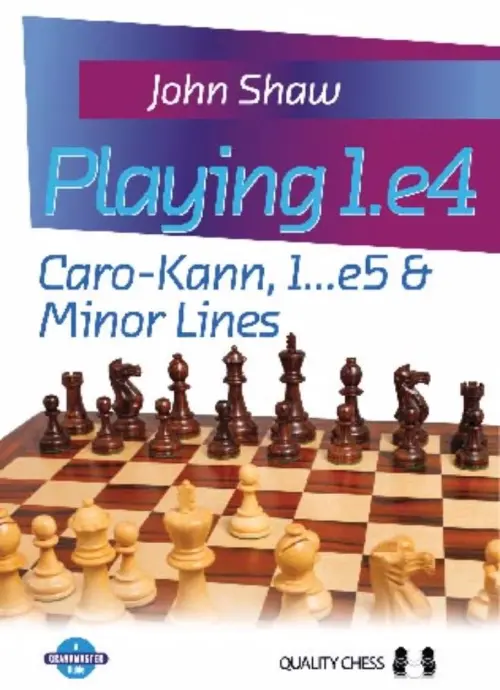
Playing 1.e4 by John Shaw (Quality Chess, 2016–2018) is the best choice for an advanced player who wants a complete main-line repertoire in a single series — three volumes covering all eight of Black’s replies.
It runs to roughly 1,500 pages in total. Volume 1 (2016) is the largest single instalment and covers six of the eight replies on its own — the Caro-Kann via the Advance with 4.h4, the Open Games via the Scotch, the Scandinavian, the Pirc and Modern, Alekhine’s, the minor replies in a dedicated rare-lines chapter, and the Philidor as a bonus. Volume 2 (2018) adds the French and the Sicilian sidelines; Volume 3 (2018) completes the set with the Sicilian main lines.
Sean Marsh reviewed it positively on structure and completeness, with the caveat that it is massive and very dense — a fair warning given the page count. Some ChessPub contributors have criticized specific line choices.
The age caveat that applies to Negi applies here too: this is heavily forcing main-line material published in 2016–2018, and that is the kind of repertoire most exposed to new theory.
A note on age. This guide weighs a book’s age against its own theory load. The sharp main-line repertoires (Negi, 2014-2016 at its core; Shaw, 2016-2018) carry the most forcing analysis and are the most exposed to new theory. A low-theory repertoire like Sielecki’s is built to age more slowly.
Coffeehouse Repertoire 1.e4 — Gawain Jones (Quality Chess, 2021)

Coffeehouse Repertoire 1.e4 by Gawain Jones (Quality Chess, 2021) is the best 1.e4 repertoire for players who want aggressive, practical lines that sidestep main-line theory — two volumes covering all eight replies, reviewed positively by IM John Watson for the soundness and integrity of the repertoire.
Rather than following the main roads, Jones builds a repertoire designed to sidestep the heaviest theory. Two volumes, around 1,000 pages together. Volume 1 handles the Sicilian, Caro-Kann, Scandinavian and Alekhine’s; Volume 2 covers the Open Games, French, Pirc/Modern, the minor replies and the Philidor.
Watson’s review, in Chess Life, also noted explicitly that its theoretical burden makes it unsuitable for beginners.
If the appeal of a repertoire is that your opponent is out of preparation early, this is the one built for that.
Grandmaster Repertoire: 1.e4 — Parimarjan Negi (Quality Chess, 2014–2020)
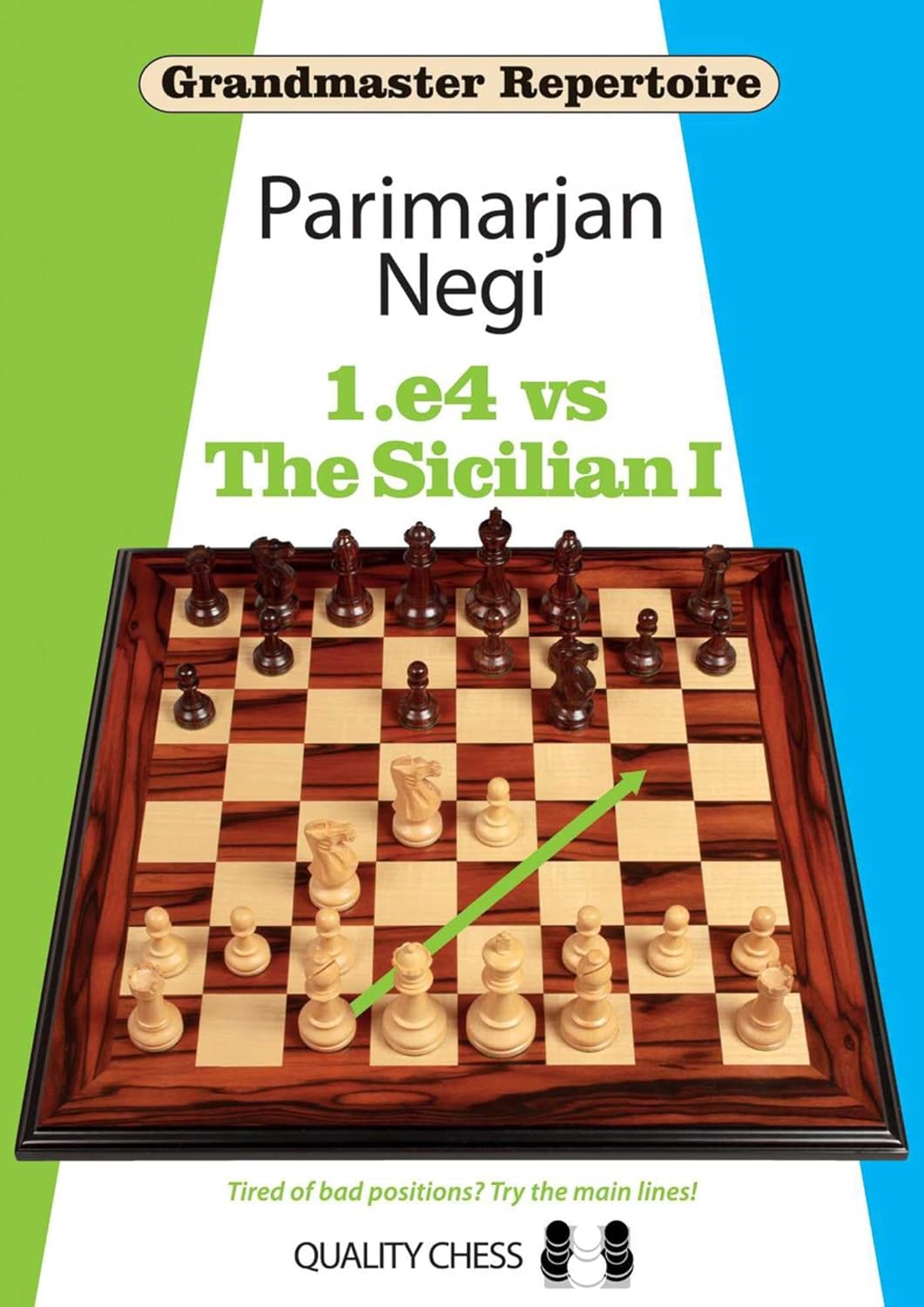
Grandmaster Repertoire: 1.e4 by Parimarjan Negi (Quality Chess, 2014–2020) is the deepest 1.e4 treatment in print, but it is not a complete repertoire — its five volumes cover seven of Black’s eight major replies, with no answer to the 1…e5 main lines anywhere in the series.
It runs to roughly 2,300 pages. Volume 1 (2014) covers the French, Caro-Kann and Philidor. Volumes 2 (2015), 3 (2015) and 4 (2016) work through the Sicilian — the Najdorf, then the Dragon, Rauzer, Sveshnikov and Kalashnikov, then the Taimanov, Kan and Scheveningen. Volume 5 (2020) covers Alekhine’s, the Scandinavian, the Pirc and Modern, and the minor replies.
Two caveats matter before you buy it, and neither is a matter of quality.
The first is a genuine gap. The series has no answer to the Open Games main lines — there is no Ruy Lopez, Scotch or Italian volume, and none exists in the publisher’s five-title catalogue. The only 1…e5 material anywhere in the five books is the Philidor, in Volume 1. That leaves seven of the eight replies covered, and it means a Negi buyer needs a separate source for 1…e5.
The 1…e5 gap. The Negi series has no answer to the Open Games main lines. There is no Ruy Lopez, Scotch or Italian volume anywhere in the five books; the only 1…e5 material is the Philidor in Volume 1. A Negi buyer needs a separate source for 1…e5.
The second is age. The sharp main-line theory in the earlier volumes dates from 2014–2016. This guide weights age against a book’s own theory load rather than its year alone, and a heavily forcing main-line repertoire is the case where that weighting bites hardest.
A note on age. This guide weighs a book’s age against its own theory load. The sharp main-line repertoires (Negi, 2014-2016 at its core; Shaw, 2016-2018) carry the most forcing analysis and are the most exposed to new theory. A low-theory repertoire like Sielecki’s is built to age more slowly.
On merit the reviews are strong: GM Matthew Sadler was strongly positive on the Sicilian volume, and British Chess News reviewed the Minor Defences volume positively. But multiple independent community sources put the practical floor for this series at roughly 1800–2300 and above, and GM Kevin Goh described it as a little overwhelming for non-elite players. This is a series for players who already have a strong 1.e4 foundation.
Which 1.e4 repertoire is best for club players?
Keep It Simple: 1.e4 – 2.0 — Christof Sielecki (New In Chess, 2023)
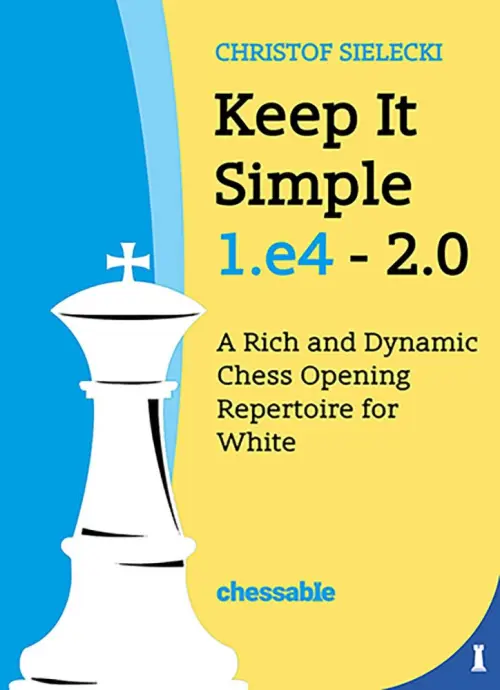
Keep It Simple: 1.e4 – 2.0 by Christof Sielecki (New In Chess, 2023) is the best complete 1.e4 repertoire for club players — one volume covering all eight of Black’s replies, built specifically to keep the memorization load low, and reviewed positively by IM John Donaldson for roughly the 1800–2300 band.
This is a revised 2.0 edition of a book first published in 2018. It covers all eight replies in around 630 pages, and the design goal is stated in the title: choose sound lines that do not require heavy memorization. The Sicilian is met with the Bb5 systems (Rossolimo and Moscow) plus the Alapin rather than the Open Sicilian, the French with the Tarrasch 3.Nd2, the Caro-Kann with the Exchange, and the 2.0 edition switched to the Ruy Lopez (chapters 1–8) inside a new ten-chapter Open Games section.
Donaldson’s review, in Chess Life, noted that the low-maintenance design suits club through lower-advanced players, while explicitly excluding beginners. GM Matthew Sadler also reviewed it positively. The first edition won the ChessPub Book of the Year award for 2018.
Known criticism, from players who otherwise recommend it: the absence of Open Sicilian coverage is a real limitation if you want it.
If you are a club player who wants one complete repertoire that will not consume your study time, this is the book this guide recommends.
Which 1.e4 repertoire is best for beginners?
There is no complete 1.e4 repertoire book pitched at beginners. Every complete repertoire in this guide is explicitly framed by its reviewers as club-level or above — Sielecki’s excludes beginners, Jones’s is called unsuitable for them on theoretical grounds, and Ntirlis’s and Negi’s are framed by their reviewers as advanced material.
The nearest thing is a starter repertoire, and it should be understood as exactly that.
My First Chess Opening Repertoire for White — Vincent Moret (New in Chess, 2016)
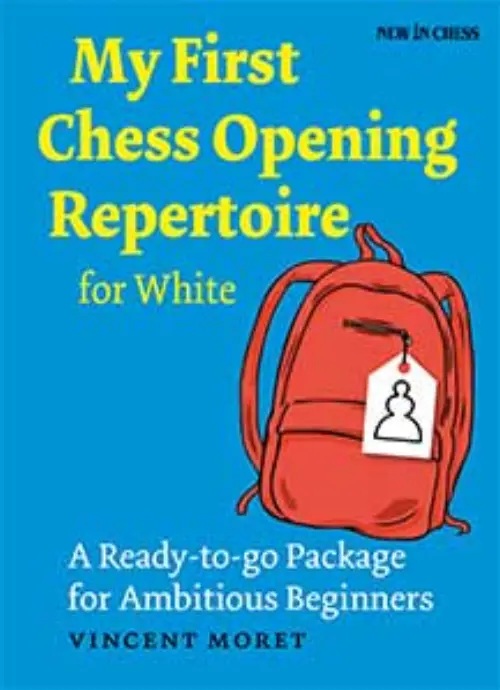
My First Chess Opening Repertoire for White by Vincent Moret (New In Chess, 2016) is the best starting point for a beginner, but it is a starter set rather than a complete repertoire — it covers around five of Black’s eight major replies, using system-based approaches chosen to be easy to learn.
It is well regarded for that purpose. Sean Marsh reviewed it positively in CHESS as a beginner and improver repertoire, IM Jeremy Silman regarded it positively for beginners, and Florian Jacobs of the Max Euwe Centre was positive for beginners and club players while explicitly saying it is not for advanced players. It recurs as a beginner favorite in community recommendations.
But it is not a complete repertoire, and the difference matters. It is built on systems that are easy to learn rather than on complete answers to every defence. It covers the Open Games with the Giuoco Piano and Pianissimo (chapters 1–3), the French with a King’s Indian Attack system, the Caro-Kann with an Advance gambit approach, and the Pirc/Modern in its own chapter. Against the Sicilian it offers only the Grand Prix Attack — an anti-Sicilian sideline, not the Open Sicilian. Coverage of the Scandinavian, Alekhine’s and the minor replies is bundled into a single closing chapter.
That works out to around five of the eight replies, with uneven depth. As a first repertoire that gets a beginner playing real chess quickly, it does its job. As a complete answer to 1.e4, it is not one, and you will outgrow it.
The practical path: start with Moret, then move to Sielecki when the starter systems stop being enough.
Which of Black’s defences does each book actually cover?
Which of the eight replies each book answers:
| Reply | Ntirlis | Sielecki | Shaw | Jones | Negi | Moret |
|---|---|---|---|---|---|---|
| Sicilian | Yes | Yes (Bb5/Alapin) | Yes | Yes | Yes | Grand Prix only |
| Open Games (1…e5) | Yes | Yes | Yes | Yes | No (Philidor only) | Yes |
| French | Yes | Yes | Yes | Yes | Yes | Yes (system) |
| Caro-Kann | Yes | Yes | Yes | Yes | Yes | Yes (system) |
| Pirc / Modern | Yes | Yes | Yes | Yes | Yes | Yes |
| Scandinavian | Yes | Yes | Yes | Yes | Yes | Not confirmed |
| Alekhine’s | Yes | Yes | Yes | Yes | Yes | Not confirmed |
| Minor replies | Yes | Yes | Yes | Yes | Yes | Not confirmed |
| Total | 8/8 | 8/8 | 8/8 | 8/8 | 7/8 | ~5/8 |
Frequently asked questions
What is the best single book for a complete 1.e4 repertoire?
For most players, one of two: Reimagining 1.e4 if you want the most recent and most compact complete repertoire, or Keep It Simple 1.e4 – 2.0 if your priority is keeping the memorization load low. Both cover all eight of Black’s major replies in a single volume.
Is Negi’s Grandmaster Repertoire still the standard?
Grandmaster Repertoire: 1.e4 remains the deepest 1.e4 material in print and reviews well, but two things temper the recommendation. It has no answer to the 1…e5 main lines anywhere in the five volumes, so you will need a second source for that reply, and its sharpest theory dates from 2014 to 2016. Community sources put its practical floor at roughly 1800 to 2300 and up.
What should a beginner play after 1.e4?
There is no complete 1.e4 repertoire book aimed at beginners. Moret’s My First Chess Opening Repertoire for White is the usual starting point and is well reviewed for that purpose, but it is a system-based starter set covering around five of the eight replies, notably meeting the Sicilian only with the Grand Prix Attack. Treat it as a first repertoire to be replaced, not a permanent one, and move to a complete repertoire such as Sielecki’s when the starter systems stop being enough.
Do I need a multi-volume set?
Only if you want the depth. Ntirlis and Sielecki both deliver complete coverage in one volume. The three-volume Shaw, two-volume Jones and five-volume Negi sets offer more detail per line, at 1,000 to 2,300 pages and a correspondingly larger investment of study time.
Which repertoire avoids the most theory?
Sielecki’s, by design. It selects sound lines chosen specifically to limit memorization. Jones’s Coffeehouse Repertoire takes a different route to a similar end, using aggressive practical lines to steer opponents out of preparation early, though reviewers note its own theoretical burden is not trivial.
How often do these books go out of date?
It depends on the repertoire, not just the publication year. A sharp main-line repertoire like Negi’s or Shaw’s carries the most forcing analysis and so is the most exposed to new theory, while a low-theory repertoire like Sielecki’s is built to age more slowly.
Final Recommendations:
One volume — pick by your level
- Keep It Simple 1.e4 – 2.0 by Sielecki — the club player’s pick; complete coverage with the lowest maintenance.
- Reimagining 1.e4 by Ntirlis — the advanced pick; the most recent complete repertoire, in the fewest pages.
Multi-volume depth — pick by your style
- Playing 1.e4 by Shaw (3 volumes) — the complete main-line series. Dense and massive; check the sharpest lines against current practice.
- Coffeehouse Repertoire 1.e4 by Jones (2 volumes) — aggressive, practical lines built to take opponents out of preparation early.
- Grandmaster Repertoire: 1.e4 by Negi (5 volumes) — the deepest theory in print, for players roughly 1800 and up. Remember the 1…e5 gap: you need a second source for the Open Games.
For beginners — read this first
There is no complete 1.e4 repertoire pitched at beginners, and none of the sets above is the place to start. The practical path: begin with My First Chess Opening Repertoire for White by Moret, a system-based starter set rather than a complete repertoire, then move to Keep It Simple 1.e4 – 2.0 when the starter systems stop being enough.
Where can I find books on a single defense?
Looking for depth on a single defense rather than a whole repertoire?
- Facing the Caro-Kann — see our guide to the best Caro-Kann books, which covers dedicated White options including Kovalchuk’s repertoire based on 2.c4.
- Facing the Sicilian Dragon — see our Sicilian Dragon guide for books devoted to that defence from both sides.
- Facing the Najdorf — see our Najdorf guide for dedicated White repertoires against the Sicilian’s most popular main line.
All the books in this guide are available on Forward Chess, where each title has a free sample to read.

- Best Pirc and Modern Defense Books: Complete Guide - October 25, 2026
- Best Italian Game Chess Books: Complete Opening Guide - October 20, 2026
- Best Books on the English Opening: A Complete Guide - October 15, 2026