
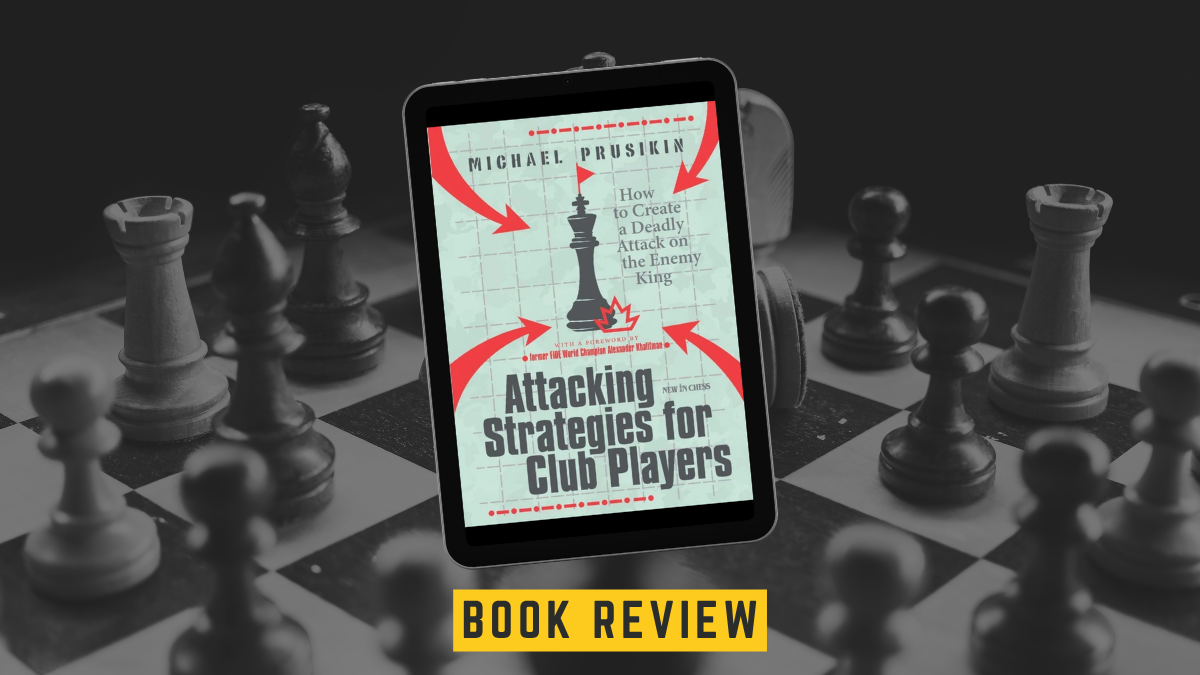
What is the core focus of Attacking Strategies for Club Players?
Attacking Strategies for Club Players, authored by GM Michael Prusikin (published by New in Chess), teaches the strategic requirements for a successful attack on the king rather than basic attacking motifs. Across 15 thematic chapters covering pawn storms, battering rams, obstructive sacrifices, and the knight on f5, it uses 89 annotated games to show players rated 1500 to 2300 how to recognize when an attack is justified and how to conduct it, finishing with a chapter of exercises and full solutions.
Book Review of Attacking Strategies for Club Players by GM Michael Prusikin
– Garry Kasparov
It’s no secret that most club players love to attack. They want to win a flashy game with lots of sacrifices, preferably at least a queen, and checkmate their opponent in the grand style of Morphy or Tal.
As former FIDE world champion Alexander Khalifman writes in the Forword:
Khalifman also writes:
Hence, since attacking skills are essential, and that the subject is inexhaustible according to Khalifman, it’s not surprising that many books continue to be written on the subject, with varying levels of exposition and target audiences.
Prusikin introduces his book as follows:
In this book we shall address the strategic requirements for a successful attack on the king and some lesser-known attacking motifs, though no less relevant in practice. I hope this will be both interesting and useful for players with an Elo rating between 1500 and 2300.”
The suggested Elo range shows that the book is aimed at the level of average club players up to the FIDE Master level.
What’s Inside – Forward Chess ebook
15 thematic chapters plus exercises · 192 pages
Attacking Themes
1. Prerequisites and rules for attacking the kingp. 13
2. King in the centrep. 15
3. Obstructive sacrificesp. 30
4. Attacking the king without the queenp. 38
5. Pawn storm with opposite-side castlingp. 48
6. Pawn storm with same-side castlingp. 60
7. The Steinitz ‘battering ram’: the h-pawn against a fianchettop. 70
8. The Alekhine ‘battering ram’: destroying king protection with the g-pawnp. 83
9. The nail in the coffinp. 90
10. Doubled g-pawnsp. 96
11. Using pieces to attack the castled positionp. 103
12. The Grand Prix Attackp. 113
13. The Chigorin ‘outrider’: the knight on f5p. 126
14. Long bishop on b2p. 134
15. Interferencep. 143
16. Breakthrough on the strong pointp. 147
Test Yourself
17. Test your attacking skillsp. 153
18. Solutionsp. 163
Rounded out by a foreword by former FIDE World Champion Alexander Khalifman, an introduction, an Index of Names, and a Bibliography.
The Table of Contents above shows that the book covers the standard attacking themes together with some unusual themes. The author also introduces some unusual descriptive terms such as the “Steinitz battering ram” and the “Chigorin outrider” in the book.
The first chapter discusses the essential conditions required for an attack to be possible and some tips for conducting the attack.
- Lead in development/uncastled opposing king
- Space advantage on the side of the board where the opposing king is located
- Few defensive pieces around our opponent’s king
- Lack of/weakened pawn protection for the king
Chapters 2 – 16 cover the various themes of attacking in chess. Each chapter starts with a brief introduction to the contents of the chapter, and the remainder of the chapter uses illustrative games to explain the theory. The chapters cover all areas of the game. There are 89 illustrative games in the book, including some played by the author.
The final chapter presents 50 exercises for the reader to solve, and complete solutions are provided. The exercises include mainly tactical positions, but some strategic examples are also included. An interesting twist is the inclusion of one exercise where a tempting attacking move is a blunder and loses. Readers are not told which exercise this is, which adds to the challenge! The exercises are given in ascending order of difficulty.
Prusikin’s commentary is clear and concise, and he manages to explain the ideas in the illustrative games very well. While he has of course used chess engines to help with the analysis, he doesn’t go overboard with computer-based variations, in keeping with the target audience.
Two examples from the book are given below, with annotations from the book.
In conclusion, Prusikin has written an excellent book on attacking principles in chess. The book uses relevant examples and clear commentary to explain the concepts. The scope of the book covers all areas of the game, and it succeeds as a teaching text for the intended audience.

Attacking Strategies for Club Players
Author: Michael Prusikin
Publisher: New In Chess
Level: Intermediate · 192 pages
Format: Interactive E-book (Forward Chess)

- Best Pirc and Modern Defense Books: Complete Guide - October 25, 2026
- Best Italian Game Chess Books: Complete Opening Guide - October 20, 2026
- Best Books on the English Opening: A Complete Guide - October 15, 2026