
The most accessible Sicilian Dragon repertoire for club players is The Dragon Sicilian by GM Anish Giri (New in Chess), a complete Black repertoire against 1.e4 that also covers the main Anti-Sicilians. The most thorough is Grandmaster Repertoire: The Dragon by GM Gawain Jones (Quality Chess), a two-volume set for advanced players.
Alongside them sit The Hungarian Dragon by Junior Tay, a low-memorization surprise weapon in the …h5 line against the Yugoslav Attack, and DragonMasters by FM Andrew Burnett (Thinkers Publishing), a two-volume games-and-history collection rather than a repertoire.
For the related systems, Chess Opening Repertoire: Accelerated Dragon by GM Nigel Davies (Popular Chess) covers the Accelerated Dragon for club players, and The Hyper Accelerated Dragon by IM Raja Panjwani (Thinkers Publishing) covers the Hyperaccelerated move order in depth. All six are available on Forward Chess with free interactive sample chapters.
What is the Sicilian Dragon?
The Sicilian Dragon arises after 1.e4 c5 2.Nf3 d6 3.d4 cxd4 4.Nxd4 Nf6 5.Nc3 g6, where Black fianchettoes the bishop to g7 and castles behind it. It is one branch of the Open Sicilian, and it has two well-known cousins that reach a g6-fianchetto by different move orders — the Accelerated Dragon and the Hyperaccelerated Dragon — which we cover in their own section because they are distinct variations, not the same opening.
Should beginners play the Sicilian Dragon?
We do not recommend the Sicilian Dragon to beginners or early intermediates. It is a sharp, theory-heavy system that rewards players who are already comfortable in tactical Sicilian positions. Simpler introductions to the Dragon exist, but if you are a newer player set on the opening, begin with the most accessible repertoire below — Giri’s — rather than the deep-theory sets, and come to it once your tactics are solid. This is our editorial judgment, not a review verdict.
The books at a glance
| Book | Author | Publisher | Year | Variation | Best For |
|---|---|---|---|---|---|
| The Dragon Sicilian | Anish Giri | New in Chess | 2025 | Classical Dragon | Club players and up; the accessible starting point |
| Grandmaster Repertoire: The Dragon (Vols 1 & 2) | Gawain Jones | Quality Chess | 2015 | Classical Dragon | Advanced players wanting the deepest theory |
| The Hungarian Dragon | Junior Tay | Independent | 2022 | Classical Dragon (…h5 line) | Club players; a surprise weapon alongside a main repertoire |
| DragonMasters (Vols 1 & 2) | Andrew Burnett | Thinkers Publishing | 2023 / 2026 | Dragon (games & history) | Enjoyment and study, not a repertoire |
| Chess Opening Repertoire: Accelerated Dragon | Nigel Davies | Popular Chess | 2025 | Accelerated Dragon | Club players who prefer the Accelerated move order |
| The Hyper Accelerated Dragon (2nd ed.) | Raja Panjwani | Thinkers Publishing | 2018 | Hyperaccelerated Dragon | Players committed to the Hyperaccelerated move order |
These books are presented by purpose and audience, not ranked against each other. Where two are genuinely co-equal — Giri and Jones for advanced players — we explain how they differ rather than forcing an order.
How should club players study the Dragon?
Recommended Study Path
Step 1: Decide if the Dragon fits you before you commit
The Dragon rewards players who are comfortable calculating in sharp, opposite-side-castling positions. If your tactics are still developing, build them first; the opening punishes vague knowledge harder than most. If you are set on it, start with the most accessible repertoire here, Giri’s, rather than the deep-theory sets.
Step 2: Pick your move order and one repertoire book
The Classical Dragon (Giri or Jones), the Accelerated (Davies) and the Hyperaccelerated (Panjwani) are distinct openings with different theory. Choose one move order, then work through a single repertoire book in full rather than sampling lines from several. Gaps in Dragon knowledge appear exactly where opponents strike.
Step 3: Drill the Yugoslav Attack positions on the interactive board
The Yugoslav Attack is the Dragon’s critical test, and it is concrete: move orders, exchange sacrifices on c3, the timing of the …d5 break. Stepping through these variations move by move and testing yourself on key positions is far more effective than reading static diagrams.
Step 4: Play it, then study the ideas behind your losses
Theoretical knowledge becomes a usable repertoire only through practice. Play the Dragon in club and online games, and when a line goes wrong, return to your book to understand the plan you missed. DragonMasters makes a fine companion here: seeing how the opening’s great practitioners handled both sides builds the pattern recognition no theory chapter can.
Which books give the best Black Dragon repertoire?
Anish Giri — The Dragon Sicilian (New In Chess, 2022)

What’s Covered
- Yugoslav Attack — 9.Bc4 with 9…Nxd4, and the main line 9.0-0-0 d5
- White’s other systems — the Classical (6.Be2), Fianchetto (6.g3), Levenfish (6.f4) and 6.Bc4
- Anti-Sicilians — the Moscow (3.Bb5+), Closed Sicilian, 2.c3 Alapin and Grand Prix Attack
- Move orders — including a bonus chapter on the Dragodorf
Giri’s The Dragon Sicilian is a complete Black Dragon repertoire against 1.e4, and the most accessible of the full repertoires here. Reviewers describe it as suitable across a wide range of levels, and one reviewer for the Mechanics’ Institute Newsletter noted that club players will find all the detail they need while stronger players are pointed toward further study. The one caveat reviewers raise is stylistic: the repertoire leans on solid, well-analysed lines rather than the old sacrificial chaos the Dragon is known for, so players who want the sharpest attacking tries may need to supplement it.
A stylistic caveat. The repertoire leans on solid, well-analyzed lines rather than the old sacrificial chaos the Dragon is known for. Players who want the sharpest attacking tries may need to supplement it.
Best for: The Dragon Sicilian suits club players and up; it is the recommended entry point to a Dragon repertoire, and it is available on Forward Chess.
Gawain Jones — Grandmaster Repertoire: The Dragon:
Volumes 1 & Volume 2 (Quality Chess, 2015)
What’s Covered
- Volume 1: 9.Bc4 and 9.g4 — the Soltis Variation with …h5, plus the Topalov and Burnett Variations
- Volume 1: Dragon themes — the g7 bishop, exchange sacrifices on c3, the …d5 break
- Volume 2: 9.0-0-0 — the modern main line with 9…d5
- Volume 2: everything else — the Classical System and White’s remaining tries
Jones is widely regarded as the leading Dragon practitioner among grandmasters, and this two-volume set is the most exhaustive Dragon repertoire in print. Reviewers call it a thorough, tested repertoire for the dedicated Dragon player, while noting that the analysis is dense — comprehensive to a degree that demands real work from the reader. For that reason it is pitched at advanced players: reviewers explicitly steer beginners and club players elsewhere, since the depth that makes it definitive is more than most players below tournament level will use. Both volumes are available on Forward Chess, and the set is treated as a single repertoire.
A note on the date. The Jones set is from 2015, and the Dragon’s sharpest Yugoslav Attack lines are exactly where engine-driven theory moves fastest. Treat it as the deepest reference from the world’s leading Dragon specialist, and check its most critical lines against current practice.
Best for: the Jones Dragon set suits advanced players (roughly 2200+) who want the deepest, most complete theory.
Giri or Jones? They are co-equal picks for a strong player, distinguished by need, not quality: Giri is the modern, accessible, single-volume take; Jones is the deeper, denser, two-volume reference. Note also that Jones’s set dates from 2015, so its sharpest lines are the ones most worth checking against current theory.
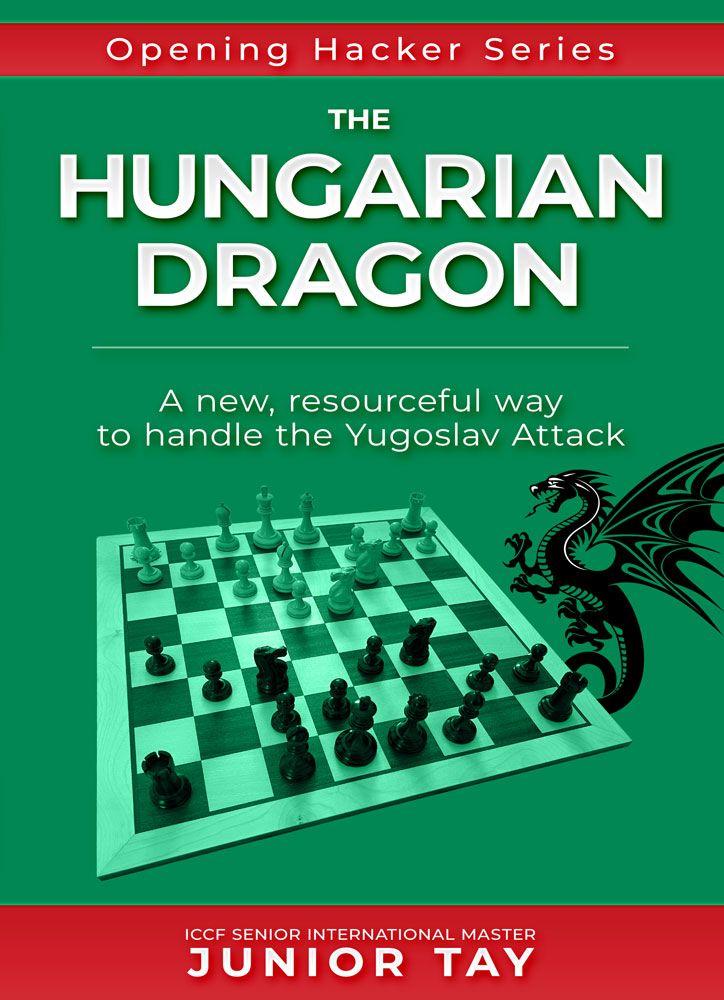
Junior Tay — The Hungarian Dragon (CarstenChess, 2022)
What’s Covered
- The …h5 method — 6.Be3 Nc6 7.f3 h5 against the Yugoslav Attack, the whole book
- Concepts and tactics — model examples and analytical positions rather than dense trees
Tay’s The Hungarian Dragon is a narrow, focused book rather than a full repertoire: it covers Black’s …h5 method against the Yugoslav Attack — reached after (1.e4 c5 2.Nf3 d6 3.d4 cxd4 4.Nxd4 Nf6 5.Nc3 g6 6.Be3 Nc6 7.f3 h5!?)
Reviewers praise it as concise, well-organised and fresh, and frame it as a low-memorization surprise weapon — a practical third option, or a way to buy time before diving into heavier theory. Treat it as a complement to a main repertoire, not a replacement for one.
Best for: The Hungarian Dragon suits club players who want a low-prep surprise weapon alongside a complete repertoire.
Scope note. The Hungarian Dragon is a focused 124-page book on one line, not a full repertoire. Treat it as a complement to a complete repertoire such as Giri or Jones, not a replacement for one.
What Dragon books cover games and history?
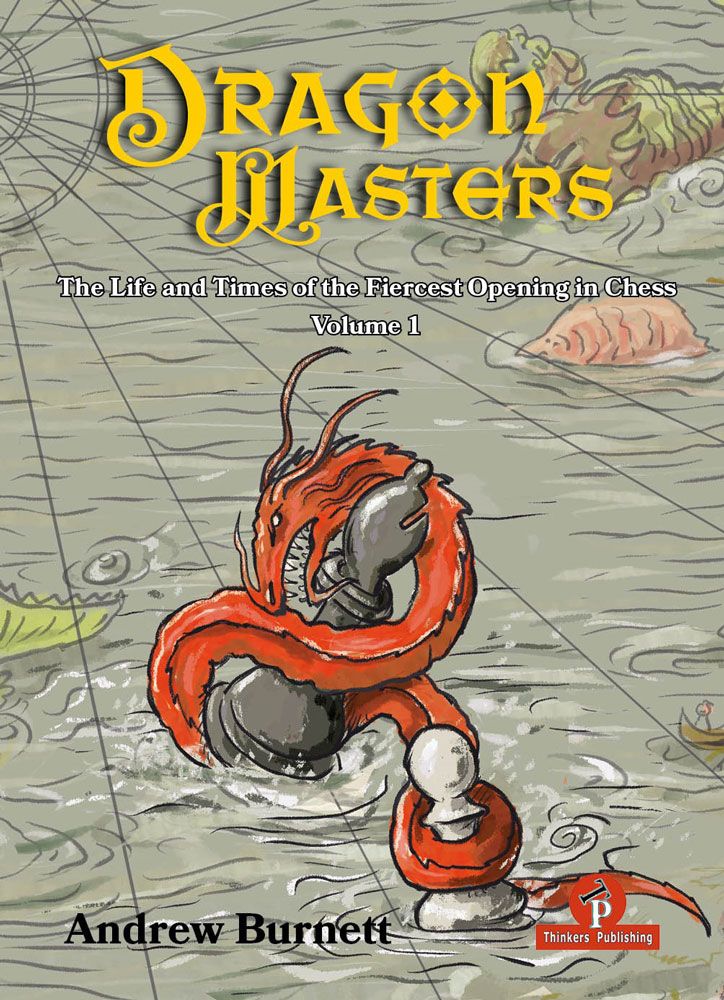
Andrew Burnett — DragonMasters, Volume 1 (Thinkers Publishing, 2024)
What’s Covered
- Volume 1 — the opening’s history to 1975: World Champions, code-breakers and revolutionaries
- Volume 2: Resurrection — 1975 through the 1990s, from Karpov’s dominance to the Dragon’s return
- Games and stories — historically important games from both sides of the opening
A history and games collection, not a repertoire. Volume 3 is in preparation.
DragonMasters is not a repertoire — it is a collection of historically important Dragon games and stories, covering players on both sides of the opening. Reviewers describe it as an essential and enjoyable addition to a Dragon player’s shelf, valuable to Dragon players and their opponents alike. Read it to absorb the ideas and history of the opening, not to learn a set of lines to play.
Best for: DragonMasters is for enrichment and enjoyment — a companion to a repertoire book, not a substitute for one.
What are the Accelerated and Hyperaccelerated Dragon, and which books cover them?
These two openings reach a kingside fianchetto like the Dragon, but by different move orders, and they are genuinely distinct variations — we keep them separate from the Classical Dragon and do not rank them against it.
Nigel Davies — Chess Opening Repertoire: Accelerated Dragon (Popular Chess, 2025)

What’s Covered
- Accelerated move order — 1.e4 c5 2.Nf3 Nc6 3.d4 cxd4 4.Nxd4 g6, with the …d5 break in one go
- The Maroczy Bind — 5.c4, with detailed ways for Black to fight the clamp
- Q&A method — the reader’s understanding is tested throughout
The Accelerated Dragon is reached by 1.e4 c5 2.Nf3 Nc6 3.d4 cxd4 4.Nxd4 g6, playing …g6 early and without an early …d6.
Davies offers a Black repertoire in this system; reviewers recommend it for club players interested in the Accelerated Dragon, and one reviewer for Chess Life endorsed his choice of the Gurgenidze setup.
Best for: Davies’s Accelerated Dragon suits club players who prefer the Accelerated move order.
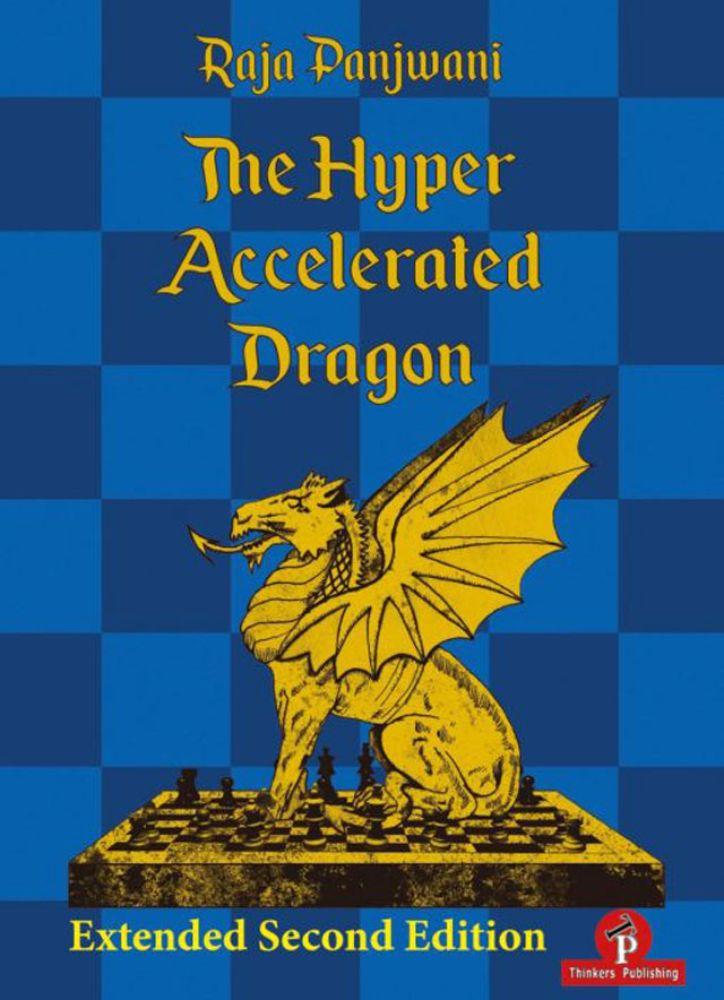
Raja Panjwani — The Hyper Accelerated Dragon, Extended Second Edition (Thinkers Publishing, 2018)
What’s Covered
- The move order — 1.e4 c5 2.Nf3 g6, the fianchetto on move two
- Classical System — White’s Be2 setups
- Maroczy Bind — both the Breyer Variation and the main line
- 4.Qxd4 and Anti-Sicilians — the queen recapture, plus the Alapin and Morra Gambit
The Hyperaccelerated Dragon goes further still, with 1.e4 c5 2.Nf3 g6 — the fianchetto on move two. Panjwani’s book is a Black repertoire in this line, and reviewers rate it highly and single out the depth of its analysis. They also flag it clearly as an advanced book: it demands work at the board rather than passive reading, and is not aimed at club-level players.
Best for: Panjwani’s Hyper Accelerated Dragon suits advanced players committed to the Hyperaccelerated move order.
How do you face the Dragon as White?
This guide covers the Dragon from Black’s side. If you meet the Dragon as White, its coverage generally lives inside a broader anti-Sicilian or 1.e4 repertoire rather than a dedicated anti-Dragon book — see our guide to full 1.e4 and anti-Sicilian repertoires.
[Coming Soon!]
Frequently asked questions
Which Sicilian Dragon book is best for club players?
The Dragon Sicilian by Anish Giri (New in Chess). Reviewers highlight it as accessible and detailed enough for club players, and it is the most approachable of the full repertoires in this guide.
Which Sicilian Dragon book is the most thorough?
Grandmaster Repertoire: The Dragon by Gawain Jones (Quality Chess), a two-volume set. It is the most exhaustive Dragon repertoire in print, aimed at advanced players who want complete theory.
Is the Dragon a good opening for beginners?
We would not start a beginner or early intermediate on it. The Dragon is sharp and theory-heavy, and it rewards players already comfortable in tactical Sicilian positions. A newer player set on it should begin with the most accessible repertoire here, Giri’s, once their tactics are solid.
What’s the difference between the Dragon, the Accelerated Dragon, and the Hyperaccelerated Dragon?
They are distinct openings with different move orders. The Classical Dragon runs 1.e4 c5 2.Nf3 d6 3.d4 cxd4 4.Nxd4 Nf6 5.Nc3 g6; the Accelerated Dragon plays …g6 earlier without …d6 (1.e4 c5 2.Nf3 Nc6 3.d4 cxd4 4.Nxd4 g6); and the Hyperaccelerated Dragon fianchettoes as early as move two (1.e4 c5 2.Nf3 g6).
Are these books available on Forward Chess?
Yes. All six titles in this guide are available on Forward Chess with interactive boards and free sample chapters.
Classical Dragon — build in this order
- The Dragon Sicilian by Giri — start here; the accessible complete repertoire, Anti-Sicilians included.
- Grandmaster Repertoire: The Dragon, Vol 1 and Vol 2 by Jones — the step up for advanced players who want the deepest theory in print. The set dates from 2015, so check its sharpest lines against current practice.
- The Hungarian Dragon by Tay — a low-prep …h5 surprise weapon to run alongside your main repertoire, not instead of it.
Accelerated & Hyperaccelerated — pick your move order
- Chess Opening Repertoire: Accelerated Dragon by Davies — the club-friendly route into the Accelerated move order, with detailed anti-Maroczy coverage.
- The Hyper Accelerated Dragon by Panjwani — the deep treatment of 2…g6; it demands real work at the board.
For enrichment — alongside any of the above
DragonMasters, Vol 1 and Vol 2 by Burnett — the history of the opening through its greatest games and players. Read it for enjoyment and pattern recognition alongside a repertoire book, not as one.
For beginners — read this first
We do not recommend the Dragon to beginners or early intermediates; build your tactics first. If you are set on it, begin with The Dragon Sicilian by Giri, the most accessible repertoire here, and grow into the deeper sets later.
Last updated: July 2026. Availability and prices are verified at publication.

- Best Books on Chess Sacrifices: 6 Essential Reads - October 11, 2026
- Book Review: My First Chess Opening Repertoire - October 1, 2026
- Best Books to Study the Sicilian: A Complete Guide for White - September 18, 2026