

Last updated: August 2026
The French Defense begins 1.e4 e6. This guide is for players who already know the basics and want to actually play it — nine books, seven for the Black side and two for White players looking for a way to meet it. Most recommendations below name the reader level they suit, because the range here runs from a 240-page introduction to a three-volume set of roughly 1,100 pages, and those are not books for the same person.
If you are new to the opening, start with First Steps: The French; the club and advanced sections below each offer two books that suit different readers rather than a single best pick.
The French Defense – 1.e4 e6 2.d4 d5
A note on how these were chosen: books are grouped by the reader they suit and the system they cover, not ranked against each other. Where two books genuinely serve the same reader in different ways, both are listed and the difference is explained rather than resolved into an order.
Playing the French: books for Black
If you are new to the French: First Steps: The French
Verdict: First Steps: The French is a starting point, and deliberately not a complete repertoire.
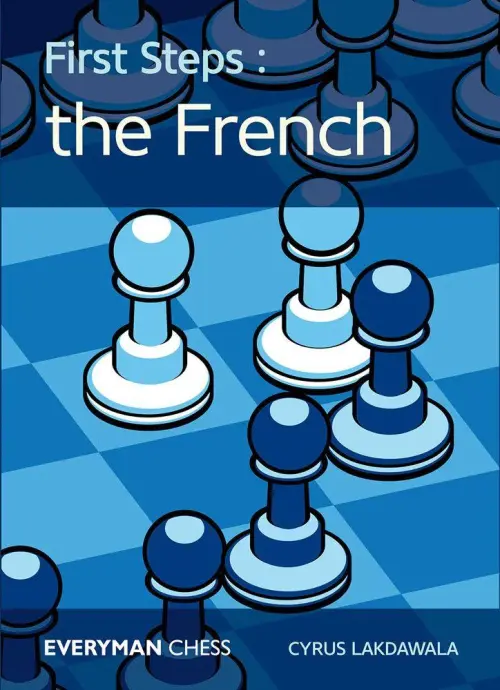
Cyrus Lakdawala’s First Steps: The French (Everyman Chess, 2016, around 240 pages) is an introductory survey of the opening’s main systems. Writing in US Chess News, Vanessa West called it “an excellent tool when learning a new opening for the first time.”
The same review is equally clear about its limit: it “can’t serve as your one source for a complete French Defense repertoire.” That is the book’s design rather than a shortcoming — it is aimed at beginner through club level, and a reader who wants a full repertoire to play from should start here and then move to one of the repertoires below.
For club players: two different approaches
Two repertoire books suit club-level readers and take genuinely different routes: Viktor Moskalenko’s The Fully-Fledged French and Cyrus Lakdawala’s Opening Repertoire: The French Defence. Neither is ranked above the other.
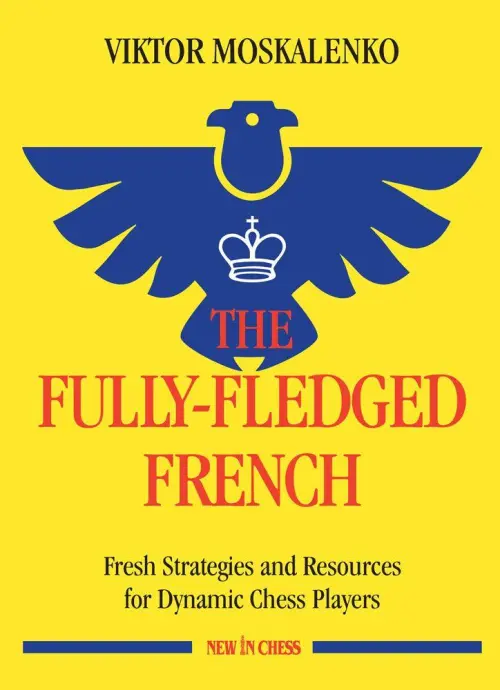
Viktor Moskalenko, The Fully-Fledged French (New In Chess, 2021, around 368 pages) is a Black repertoire covering the Advance, Tarrasch, Classical and Winawer, plus surprise weapons and sidelines. Reviewing it in CHESS magazine, Sean Marsh described it as accessible to novices, which places it lower in the rating range than most full repertoires. John Donaldson has assessed it positively.

Cyrus Lakdawala, Opening Repertoire: The French Defence (Everyman Chess, 2019, around 368 pages) is the more verbal, explanatory option — a repertoire built around talking the reader through plans. James Pratt reviewed it positively for British Chess News, with reservations about a dated bibliography.
One caveat a buyer should have: IM John Watson has written that the book’s repertoire move 13…Qf7 “appears to fall short,” and assessed the wider 4…b6 family the repertoire rests on negatively. Watson is himself the author of a competing French repertoire, which is worth knowing when weighing it.
Which to choose: Moskalenko for a dynamic, ideas-led repertoire; Lakdawala if you would rather have the plans explained at length than the variations listed.
For advanced players: two established repertoires

Emanuel Berg, Grandmaster Repertoire 14/15/16 — The French Defence (Quality Chess, 2013–2015) is the most theoretically detailed option here: three volumes, built on the Winawer. Volume One (around 328 pages) covers the Winawer main lines excluding 7.Qg4; Volume Two (around 304 pages) covers 7.Qg4 including the Poisoned Pawn; Volume Three (around 472 pages) covers the Advance, the Tarrasch and White’s other tries. Reviewing Volume Three, Uwe Bekemann assessed it as a book for the advanced player — one that, in his German original, does not meet a beginner’s needs.
One thing to know before buying it for the Winawer. Berg gives 7.h4 a fourteen-page chapter shared with an unrelated move. IM John Watson has since described 7.h4 as the Winawer main line, and the current theory of that line was built from 2020 onward — after these volumes were written. No source found says any of Berg’s recommendations has been refuted or replaced. A 2023 forum post surveying Black’s options against 7.Qg4 — by a poster who describes himself as an expert rather than a master, so weigh it accordingly — called the Poisoned Pawn, Volume Two’s largest section, still fine for Black, while judging one of the volume’s three systems against 7.Qg4 to be in much worse shape. But a reader buying this set specifically to play the Winawer today should expect to supplement its 7.h4 coverage.

Viktor Moskalenko, The Even More Flexible French (New In Chess, 2015, around 368 pages) is the ideas-led advanced alternative — a revised, updated and extended edition of his 2008 The Flexible French, with twelve new chapters and 28 additional games. It has the strongest review record of any book here, and a deliberate search for substantive criticism of it turned up none.
Which to choose: Berg for exhaustive theory and a Winawer-based repertoire, accepting the memorization load; Moskalenko 2015 for a lighter, more idea-driven treatment.
If you are considering both Moskalenko books: buy one, not both. Reviewing the 2021 book, Sean Marsh noted that a reader who already owns the earlier one “will be acquiring a significant amount of duplicate material.” The 2021 book is the more accessible of the two; the 2015 book goes into more detail — Glenn Flear observed that the 2021 title “doesn’t go into as much detail.”
For understanding rather than a repertoire: The French Defence: Move by Move
Verdict: Damian Lemos’s The French Defence: Move by Move is an excellent book that is explicitly not a repertoire — buy it for understanding, not to play from.
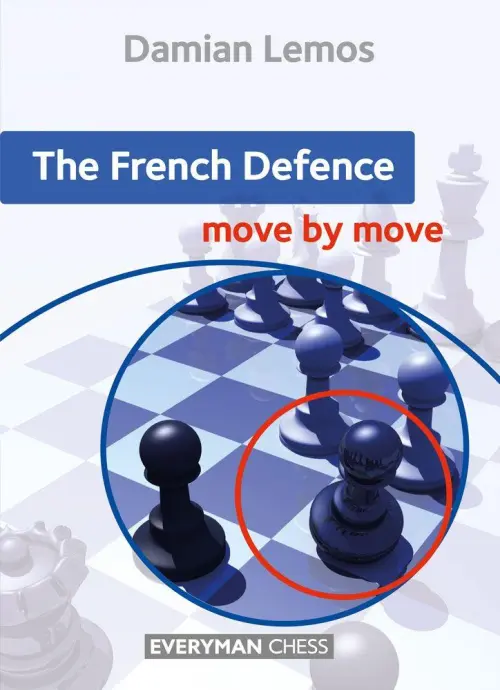
Damian Lemos’s The French Defence: Move by Move (Everyman Chess, 2021, around 352 pages) teaches the opening through annotated games and question-and-answer prompts. The author states in his own preface that the book “is not a complete opening repertoire” and “is not a comprehensive coverage of all possible variations,” and that the focus is instead “on strategic plans, positional understanding and putting the reader to the test.”
Reviewers agree with him on what the book is. Davide Nastasio (Chess News and Views) treats the non-repertoire design as the point, and P.P.O. Kane’s review reaches the same conclusion while noting specific omissions, including the Réti Gambit and the 4.Nge2 and 4.a3 lines against the Winawer. No source found calls its analysis wrong.
The standard work: Play the French
Verdict: John Watson’s Play the French is the standard repertoire book on the French — but its author’s current thinking now lives elsewhere.
John Watson’s Play the French (Everyman Chess, 4th edition, 2012, around 432 pages) has been in print across four editions since 1984, a complete Black repertoire against all of White’s main options. Reviewing it for ChessCafe, Carsten Hansen placed it “well beyond the level of most players rated below 1800” — this is a book for ambitious tournament players.
Two things a buyer should weigh. Watson continues to write on the French elsewhere, including a January 2025 column analyzing a Gukesh–Ding game and a November 2023 piece on Winawer sidelines — so the 2012 book is not where his most recent work on the opening sits. And no source found says any of its recommendations has been refuted.
Availability: this book is not currently on Forward Chess. Readers who want a comparably detailed advanced repertoire from the platform should look at Berg's three-volume set above.
Facing the French: systems for White
This section covers books dedicated to meeting the French. The other way to meet it is inside a complete 1.e4 repertoire.
If that is what you want, see our 1.e4 repertoire guide, which covers Parimarjan Negi’s 1.e4 vs The French, Caro-Kann and Philidor and John Shaw’s Playing 1.e4: French Defence & Sicilian Sidelines. The two books below are for players who want a dedicated treatment of one system.
The Exchange Variation: The Exchange French Comes to Life

Alex Fishbein’s The Exchange French Comes to Life (Russell Enterprises, April 2021, around 240 pages) presents a White repertoire in the Exchange Variation based on 4.Nf3. It carries a foreword by John Watson.
IM Dirk Schuh recommended it without reservation. Peter Tart, reviewing for British Chess News, was positive on the repertoire’s aim while critical of chapters 9 and 10 as a poor fit for the book’s stated intent. Readers on ChessPub have questioned how much White actually gets in the key lines, one of them reporting a database check that ran against the book’s assessment — so treat its evaluations as a starting point for your own analysis rather than settled.
The main line: Beat the French Defense with 3.Nc3
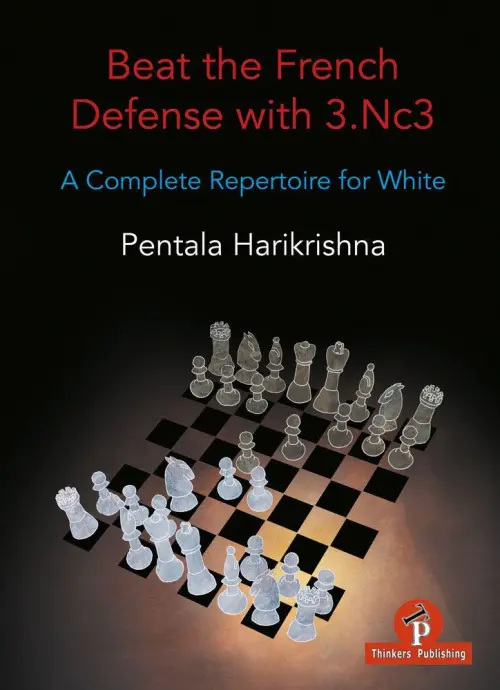
Pentala Harikrishna’s Beat the French Defense with 3.Nc3 (Thinkers Publishing, 2021, around 456 pages) is a complete White repertoire built on 3.Nc3, described on its own title page as “A Complete Repertoire for White.” Colin Lyne reviewed it positively for British Chess News.
Two things to be clear about. This is a mainline book, not an anti-Winawer weapon — it meets the Winawer with 4.exd5 rather than contesting the main battleground. And it has attracted very little published assessment for a book of its size; a deliberate search for critical reviews found none, but that reflects how little it has been publicly evaluated rather than a consensus in its favor.
At a glance
| Book | Author | Side | Level | Publisher | Year |
|---|---|---|---|---|---|
| First Steps: The French | Cyrus Lakdawala | Black | Beginner–club | Everyman Chess | 2016 |
| The Fully-Fledged French | Viktor Moskalenko | Black | Club | New in Chess | 2021 |
| Opening Repertoire: The French Defence | Cyrus Lakdawala | Black | Club | Everyman Chess | 2019 |
| The French Defence: Move by Move | Damian Lemos | Black | Club (understanding) | Everyman Chess | 2021 |
| GM Repertoire 14/15/16 (3 vols) | Emanuel Berg | Black | Advanced | Quality Chess | 2013–2015 |
| The Even More Flexible French | Viktor Moskalenko | Black | Advanced | New in Chess | 2015 |
| Play the French (4th ed.) (not on Forward Chess) | John Watson | Black | Advanced | Everyman Chess | 2012 |
| The Exchange French Comes to Life | Alex Fishbein | White | Club–advanced | Russell Enterprises | 2021 |
| Beat the French Defense with 3.Nc3 | Pentala Harikrishna | White | — | Thinkers Publishing | 2021 |
Frequently asked questions
Which French Defense book should a beginner start with?
First Steps: The French by Cyrus Lakdawala. It is an introductory survey rather than a repertoire, described in US Chess News as “an excellent tool when learning a new opening for the first time.” Its own reviewer notes it cannot serve as your only source for a complete repertoire, so plan to follow it with one of the club-level repertoires.
Which of these is the most detailed French Defense repertoire?
Emanuel Berg's three-volume Grandmaster Repertoire 14/15/16 (Quality Chess, 2013–2015), running to roughly 1,100 pages across the set and built on the Winawer. Note that its 7.h4 coverage predates the modern development of that line.
Is John Watson's Play the French still worth buying?
It has been in print across four editions since 1984, and no source found says any of its recommendations has been refuted. It is pitched beyond the level of most players rated below 1800, its most recent edition is from 2012, and the author's current work on the French appears in his columns rather than in the book. It is not currently available on Forward Chess; readers who want a comparably detailed advanced repertoire from the platform should look at Berg's three-volume set.
Which books cover the French for White?
Two dedicated options are covered above: Fishbein on the Exchange Variation and Harikrishna on 3.Nc3. The other way to meet the French is inside a wider 1.e4 repertoire — see our 1.e4 repertoire guide for those.
Do I need both Moskalenko books?
No. Reviewing the 2021 Fully-Fledged French, Sean Marsh noted that owners of the earlier book “will be acquiring a significant amount of duplicate material.” Choose the 2021 book for accessibility or the 2015 book for greater depth.
Final Recommendations:
Which French Defense Book Should You Choose?
For beginners
First Steps: The French by Lakdawala — a starting point for learning the French, and deliberately not a complete repertoire. Start here, then move to one of the club-level repertoires below.
For club players — either/or
- The Fully-Fledged French by Moskalenko — a dynamic, ideas-led repertoire.
- Opening Repertoire: The French Defence by Lakdawala — if you would rather have the plans explained at length than the variations listed.
Neither is ranked above the other; they take genuinely different routes.
For advanced players — either/or
- Grandmaster Repertoire 14/15/16 by Berg (3 volumes) — for exhaustive theory and a Winawer-based repertoire, if you are willing to accept the memorization load.
- The Even More Flexible French by Moskalenko (2015) — for a lighter, more idea-driven treatment.
If choosing between the two Moskalenko books, buy one, not both (see note).
For understanding
The French Defence: Move by Move by Lemos — an excellent book that is explicitly not a repertoire. Buy it for understanding, not to play from directly.
The standard work
Play the French by John Watson — the standard repertoire book on the French, but its author’s current thinking now lives elsewhere. It is not on Forward Chess; Berg’s set is the on-platform alternative for a comparably detailed advanced repertoire.
For White — facing the French
- The Exchange French Comes to Life by Fishbein — a White repertoire in the Exchange Variation based on 4.Nf3.
- Beat the French Defense with 3.Nc3 by Harikrishna — a complete mainline repertoire based on 3.Nc3 (it meets the Winawer with 4.exd5 rather than contesting it).
The other way to meet the French is within a complete 1.e4 repertoire — see the 1.e4 guide.

- Best Pirc and Modern Defense Books: Complete Guide - October 25, 2026
- Best Italian Game Chess Books: Complete Opening Guide - October 20, 2026
- Best Books on the English Opening: A Complete Guide - October 15, 2026