
Last updated: July 2026
The best London System books for White are The London System in 12 Practical Lessons by Oscar de Prado (New in Chess), which teaches the opening through plans rather than memorized variations, and Chess Opening Repertoire: The London System by IM Cyrus Lakdawala (Popular Chess), the newest and most explanatory single volume. Both are complete White repertoires pitched at club players.
Alongside them, The Agile London System by Romero and de Prado is the established encyclopedic reference, The Modernized London System by Milos Pavlovic (Thinkers Publishing) is the most analysis-dense modern treatment, and Winning with the Modern London System by Nikola Sedlak teaches the system through richly annotated games across two volumes. For the 2.Nc3 relative, Opening Repertoire: The Jobava London System by GM Simon Williams is the only dedicated book.
To face the London as Black, the two dedicated repertoires are The London Files by Kotronias and Ivanov (Russell Enterprises), the deepest and most analytical, and Fighting the London System by GM Kiril Georgiev (Chess Stars), the most practical and popular. All are available on Forward Chess with free interactive sample chapters.
Which London System books are worth considering?
| Book | Author | Publisher | Year | Side | Best For |
|---|---|---|---|---|---|
| The London System in 12 Practical Lessons | Oscar de Prado | New in Chess | 2021 | White | Learning the London through plans, not memorization |
| Chess Opening Repertoire: The London System | Cyrus Lakdawala | Popular Chess | 2025 | White | The newest, most explanatory single volume |
| The Agile London System | Romero & de Prado | New in Chess | 2016 | White | The established encyclopedic reference |
| The Modernized London System | Milos Pavlovic | Thinkers Publishing | 2024 | White | The most analysis-dense treatment |
| Winning with the Modern London System (2 vols) | Nikola Sedlak | Chess Evolution | 2016–2017 | White | Learning the system through annotated games |
| Opening Repertoire: The Jobava London System | Simon Williams | Everyman Chess | 2024 | White | The Jobava (2.Nc3) sideline, see caveats |
| First Steps: The Colle and London Systems | Cyrus Lakdawala | Everyman Chess | 2022 | White | A beginner’s first primer, paired with the Colle |
| The London Files: Defanging the London System | Kotronias & Ivanov | Russell Enterprises | 2023 | Black | The deepest anti-London repertoire |
| Fighting the London System | Kiril Georgiev | Chess Stars | 2017 | Black | The most practical, popular anti-London |
What is the London System?
The London System is a White opening reached after 1.d4 and an early development of the dark-squared bishop to f4. The books below build a White repertoire on that 2.Bf4 move order, meeting Black’s various replies — the Classical setups with …d5 and …e6, the King’s Indian and Grünfeld fianchetto defenses, the Benoni, and the Dutch.
The London System: White develops the bishop to f4 early, after 1.d4 d5 2.Bf4.
A close relative, the Jobava London, reaches a similar structure by a different move order — 1.d4 d5 2.Nc3 Nf6 3.Bf4 — and is treated in its own section below.
How should club players study the London System opening?
Recommended Study Path
Step 1: Decide how you want to learn the system
The five White repertoires here differ less in quality than in teaching method. De Prado teaches through plans and structures, Sedlak through annotated games, Lakdawala through question and answer, Pavlovic through dense analysis, and Romero and de Prado through encyclopedic coverage. Pick the method that matches how you actually study, then commit to one book.
Step 2: Learn the structures before the move orders
The London reaches a small family of recurring pawn structures by many different move orders. Time spent understanding those structures, the role of the f4 bishop, the …Qb6 counter, the c3 and e3 setup, and the typical endgames, transfers to every line. This is why the low-theory books work: the understanding carries where memorized moves would not.
Step 3: Drill the fianchetto defenses on the interactive board
The King’s Indian and Grunfeld setups with …g6 are where London players most often go wrong, and they are the reason Sedlak devoted a second volume to them. Stepping through these lines move by move and testing yourself on the key positions is far more effective than reading static diagrams.
Step 4: Play it, then read what your opponent knew
Once the system is in your games, the fastest way to find its gaps is to look at it from the other side. The London Files and Fighting the London System are written for Black, and reading how strong players plan to meet your setup will show you which of your lines actually carry the pressure.
Which London System book is best for club players?
These five White repertoires are presented as alternatives, not a ranking. They differ less in quality than in how they teach the system and how much theory they ask you to carry.
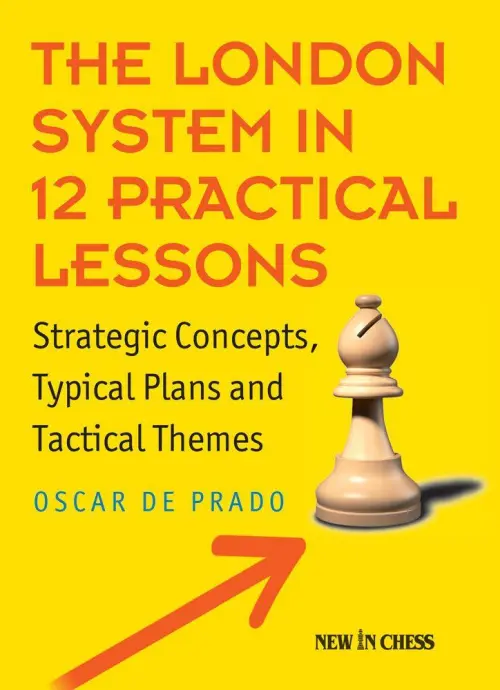
The London System in 12 Practical Lessons — Oscar de Prado (New In Chess, 2021)
What’s Covered
- Core move orders and ideas — the foundation the twelve lessons build on
- Typical attacking plans — the assault on b2, the early h4 thrust, the f2-f4 schemes and queenside play
- Recurring middlegame motifs — good knight versus bad bishop, and the key queen maneuvers
- The typical London endgames — the simplified positions the system so often steers toward
- Latest theoretical developments — one lesson keeping the repertoire current, plus a closing exercises chapter
The London System in 12 Practical Lessons by Oscar de Prado (New In Chess, 2021) is the best choice for a club player who wants to learn the London through plans rather than memorized variations. GM Matthew Sadler praised its thematic, lesson-based organization. It teaches the system through twelve self-contained lessons on structures, typical plans, and the endgames the London steers toward — the lowest-theory way into the opening. It is de Prado’s second London book, after co-authoring The Agile London System.
Chess Opening Repertoire: The London System — Cyrus Lakdawala (Popular Chess, 2025)

What’s Covered
- Classical System with …d5 and …e6 — the main tabiya, including the “Ruy Lopez” version and the Exchange Variations
- Lines where Black delays or omits …e6 — plus the symmetrical structures
- The fianchetto defenses — the King’s Indian, Grünfeld and Modern
- The rest of Black’s arsenal — the Queen’s Indian, Benoni Poisoned Pawn lines, reversed Reti setups and the Dutch
Chess Opening Repertoire: The London System by Cyrus Lakdawala (Popular Chess, 2025) is the newest and most explanatory single-volume London repertoire. Sean Marsh, writing in CHESS, called it “the most up-to-date coverage of the London System to date.” It is a pure 2.Bf4 repertoire written in Lakdawala’s question-and-answer teaching style; the community praises its explanatory, plans-driven approach. Lakdawala is a prolific opening author, and this is his third pass at a London repertoire since 2010.
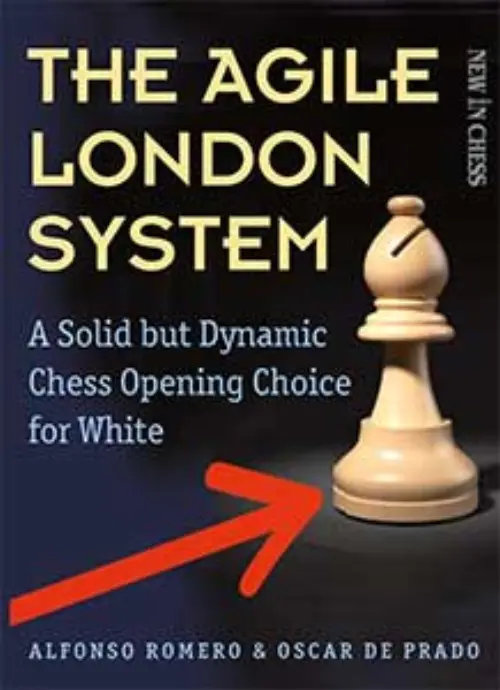
The Agile London System — Alfonso Romero Holmes & Oscar de Prado (New In Chess, 2016)
What’s Covered
- The fianchetto defenses — the Grünfeld and the King’s Indian, both after 1.d4 Nf6 2.Bf4 g6 3.e3 Bg7, separated by whether Black follows with …d5 or …d6. Four parts each, the longest treatment in the book.
- The …d5 structures — two four-part chapters, one where Black delays …e6 and one with the early …e6 after 3.e3 e6 4.Nf3, plus the Slav with 3…Bf5 4.c4.
- The …e6, …c5 and …f5 replies — the Queen’s Indian (2…e6 3.Nf3 b6), the Benoni (2…c5) and the Dutch (1.d4 f5 2.Nf3 Nf6 3.Bf4).
- Other defenses and the Pereyra Attack — a two-part chapter on Black’s remaining tries, and a dedicated closing chapter on the Pereyra.
- Context and testing — an opening chapter on the London’s historical evolution, and a chapter of tactics and strategy exercises.
Nine of the book’s twelve chapters are devoted to a specific Black defense, which is where its reputation for breadth comes from. Every line is given through the pure 2.Bf4 move order.
The Agile London System by Alfonso Romero Holmes and Oscar de Prado (New In Chess, 2016) is the established encyclopedic reference — the community’s long-standing default single-volume London, with the broadest coverage. Reviewer H. Wilders (Nederlands Dagblad) judged it the more in-depth of the popular options, and the review site fullcityplus called it “encyclopedic in scope.”
An honest caveat. Several readers praise the breadth of this book more than its depth, with forum reviewers noting that it offers wide coverage rather than deep original analysis. It remains the reference of record; it is not the place to look for the sharpest new ideas.
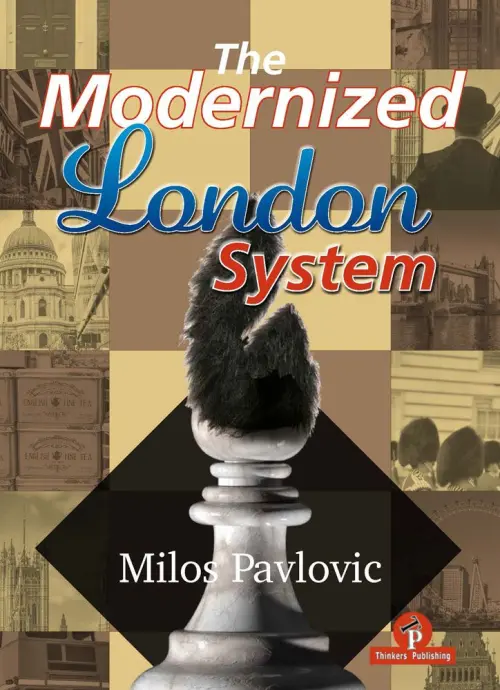
The Modernized London System — Milos Pavlovic (Thinkers Publishing, 2024)
What’s Covered
- 1.d4 d5 2.Bf4 — the overwhelming focus of the book
- Coverage for both sides — the ideas are explained from Black’s point of view as well as White’s
- Transpositions — the move-order crossovers that run through the whole London
Around 25 pages are given to 1.d4 d5 2.Nf3 Nf6 3.Bf4; the 1.d4 Nf6 2.Bf4 lines without an early …d5 need a second source.
The Modernized London System by Milos Pavlovic (Thinkers Publishing, 2024) is the most comprehensive and analysis-dense of the modern London treatments. IM John Donaldson praised its “comprehensive coverage” with “plenty of prose to explain key ideas,” and reviewer Stjepan Tomić called it “perfectly sound, playable on any level.” Tomić notes it is really aimed at the serious, tournament-minded player rather than the beginner — for whom he recommends a different resource. It is the strongest pick here for advanced study.
A scope note. This book concentrates almost entirely on the positions after 1.d4 d5 2.Bf4, with only around 25 pages given to 1.d4 d5 2.Nf3 Nf6 3.Bf4. Reviewing it, IM John Donaldson observed that players who want the London as a complete system will need a second source for the 1.d4 Nf6 2.Bf4 lines where Black does not commit to an early …d5.
Winning with the Modern London System — Nikola Sedlak (Chess Evolution, 2 vols, 2016–2017)

What’s Covered
- Part 1, organized by structure — the Caro-Kann-style setups, the early …Qb6 counter, the Classical formations with and without …e6, the Slav and symmetrical …Bf5 lines, and the King’s Indian and Grünfeld fianchetto and Queen’s Gambit approaches
- Part 1, London endgames — a dedicated chapter on the simplified positions
- Part 2, the main focus — the King’s Indian and Grünfeld setups with …g6 and the solid …e6 structures, which Part 2 treats in far greater depth than Part 1
- Part 2, extras — improvements on the first volume, the closely related Torre Attack, and an Anti-Benoni section
Winning with the Modern London System by Nikola Sedlak (Chess Evolution, two volumes) teaches the London through richly annotated games rather than variation trees. Reviewer P.P.O. Kane (The Caissa Kid) called it “a very enjoyable and instructive book” whose games are “superbly annotated,” and GM Arkadij Naiditsch took up the setup after reading the first volume. Written by a genuine London specialist across two volumes, it is a complete 1.d4 system — it meets the 1…g6 fianchetto with the Torre Attack, so it is a little broader than a pure-London book.
A note on the approach. Some stronger players find this set reads more as an instructive game collection than an exhaustive theoretical reference, and one reviewer finds it optimistic for White in places. That is a fair description of its method rather than a flaw: the games are the teaching device.
Which London System book is best for beginners?

What’s Covered
- A mixed Colle and London repertoire — both systems examined, with a practical repertoire drawn from the two
- Instructive games — carefully selected to show what both sides are trying to achieve
- Notes, tips and exercises — enough theory to get started without being overwhelmed
Roughly half the book is the London, taught through the older 2.Nf3 and 3.Bf4 move order rather than the pure 2.Bf4.
There is no dedicated beginner’s book on the London System alone. The most accessible starting point is First Steps: The Colle and London Systems by Cyrus Lakdawala (Everyman Chess, 2016) — but it should be understood for what it is: a general beginner’s primer that teaches the London bound together with the Colle System, not a reviewed, move-by-move London repertoire. It covers the London through the older 2.Nf3 and 3.Bf4 move order across roughly half the book. As a first introduction it is a gentle way in; a beginner who sticks with the London will outgrow it and move to one of the club repertoires above.
What this book is. A general beginner’s primer that teaches the London bound together with the Colle System, not a reviewed move-by-move London repertoire. It covers the London through the older 2.Nf3 and 3.Bf4 move order across roughly half the book. A beginner who sticks with the London will outgrow it.
What about the Jobava London?
What’s Covered
- The Jobava move order — 1.d4 d5 2.Nc3 Nf6 3.Bf4, a complete repertoire built on it
- Very little existing theory — the system’s newness is presented as its main practical advantage
- Denying Black autopilot — the defensive methods are not yet well established
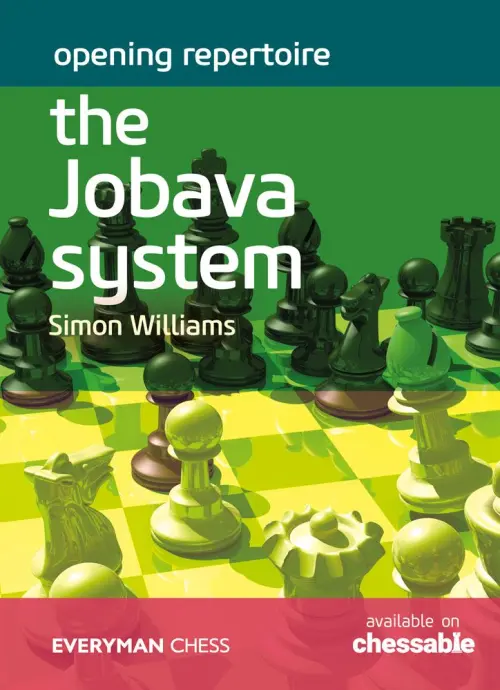
Opening Repertoire: The Jobava London System by Simon Williams (Everyman Chess, 2022) is the only dedicated book on the Jobava London — the 2.Nc3 move order (1.d4 d5 2.Nc3 Nf6 3.Bf4), which Williams presents as an aggressive, attacking-style relative of the main 2.Bf4 London. Williams, known as the “GingerGM,” is a recognized specialist in attacking systems, which suits the Jobava’s style.
Two honest caveats: there is no major published review of this book, and its community reception, while positive, is limited — so it is included here as the sole treatment of the variation rather than a firmly-reviewed recommendation. Forum reviewers also note that its coverage of one critical modern line (with 10.Ng5) is less complete than dedicated theory works. If you want to play the Jobava specifically, it is the book to start from; treat it as a starting point rather than a last word.
Two honest caveats. There is no major published review of this book, and forum reviewers note that its coverage of one critical modern line, with 10.Ng5, is less complete than dedicated theory works. It is included here as the sole book-length treatment of the Jobava rather than as a firmly reviewed recommendation.
Which book is best for facing the London as Black?
Two dedicated repertoires cover playing against the London, and they suit different readers.
The London Files: Defanging the London System — Kotronias & Ivanov (Russell Enterprises, 2023)
What’s Covered
- King’s Indian setups — the first of four separate Black systems
- The London Benoni — the …c5 counter
- The London Nimzo-Indian and Queen’s Indian — including the lines where White plays c2-c4
- The London Orthodox System — the 1.d4 d5 setups, against 2.Nf3, 2.Bf4 and 2.c3
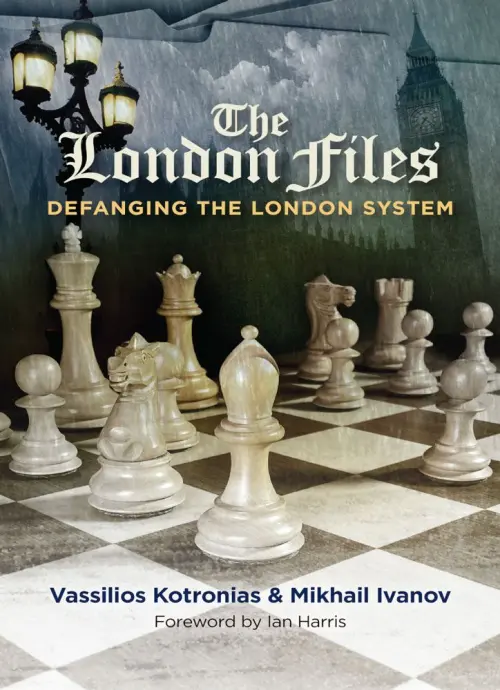
The London Files: Defanging the London System by Vassilios Kotronias and Mikhail Ivanov (Russell Enterprises, 2023) is the deepest anti-London repertoire for Black. It presents four distinct Black systems against the London — King’s Indian setups, the London Benoni, the London Nimzo- and Queen’s-Indian, and the London Orthodox — by two grandmaster authors. Reviewer P.P.O. Kane called it “a cornucopia of a book” offering “a versatile suite of astute remedies.” Kotronias is a prolific opening theoretician whose work is dense and pitched at the serious player, so this is the choice for a club-to-advanced reader who wants analytical depth.
Fighting the London System — Kiril Georgiev (Chess Stars, 2017)

What’s Covered
- The main move order — a Black repertoire against 1.d4 d5 2.Bf4
- Alternative move orders — the 2.Nf3 sequences and 1.d4 Nf6 2.Bf4 c5
- Several setups for Black — which also makes the book useful reading for White players
Fighting the London System by Kiril Georgiev (Chess Stars, 2017) is the most practical and popular anti-London choice. It is the highest community-rated anti-London title, praised across independent forums for its original analysis and rich options, and one reviewer engine-checked its lines and found them sound. Georgiev is an elite-strength grandmaster who has written on the London from both sides. One caveat: its coverage is slanted toward …d5 defenses, so it is a little less tailored if you meet 1.d4 Nf6 2.Bf4 and prefer …d6 or King’s-Indian setups.
Frequently asked questions
What is the best single book to learn the London System?
For most club players, one of two: The London System in 12 Practical Lessons by de Prado if you want to learn through plans and typical structures, or Chess Opening Repertoire: The London System by Lakdawala if you want the newest and most explanatory single volume. Both are complete White repertoires recommended by expert reviewers.
Which London book has the most detailed coverage?
The Modernized London System by Pavlovic is the most analysis-dense of the modern repertoires, and The Agile London System by Romero and de Prado is the established encyclopedic reference, though the latter is praised for breadth more than depth.
Is there a London book for complete beginners?
Not a dedicated one. First Steps: The Colle and London Systems by Lakdawala is the usual entry point and is the only title here that Forward Chess lists at beginner level, but it is a general primer bound with the Colle System rather than a full London repertoire, and it is a gentle introduction you will outgrow.
What is the Jobava London, and is there a book for it?
The Jobava London is a relative of the main London, played with an early 2.Nc3 after 1.d4 d5 2.Nc3 Nf6 3.Bf4. Opening Repertoire: The Jobava London System by Simon Williams is the only dedicated book on it, though it has no major published review.
How do I face the London as Black?
Two dedicated repertoires. The London Files by Kotronias and Ivanov offers the deepest and most analytical treatment, presenting four separate Black systems, while Fighting the London System by Georgiev is the most practical and popular choice. Several complete Black repertoires against 1.d4 also include a London chapter.
Final Recommendations:
For White — pick by how you learn
- The London System in 12 Practical Lessons by de Prado — if you learn best from plans and structures. The lowest-theory way into the opening.
- Chess Opening Repertoire: The London System by Lakdawala — if you want the newest coverage and a question-and-answer teaching style. Built on the pure 2.Bf4 move order.
- Winning with the Modern London System by Sedlak (2 volumes) — if you learn best from annotated games. Part 2 covers the fianchetto defenses that give London players the most trouble.
- The Modernized London System by Pavlovic — if you want the densest analysis. Note its focus on 1.d4 d5 2.Bf4.
- The Agile London System by Romero and de Prado — the reference to own for breadth, rather than the one to learn from first.
For the Jobava London — 2.Nc3
Opening Repertoire: The Jobava London System by Williams is the only dedicated book on the 2.Nc3 move order. If you want to play the Jobava specifically, it is where to start; treat it as a starting point rather than a last word.
For beginners — start here
First Steps: The Colle and London Systems by Lakdawala is the gentlest way in and the only title here that Forward Chess lists at beginner level. It teaches the London bound together with the Colle, so treat it as a first introduction to be replaced, then move to one of the club repertoires above.
For Black — facing the London
- The London Files by Kotronias and Ivanov — four separate Black systems and the deepest analysis. For the club-to-advanced reader who wants detail.
- Fighting the London System by Georgiev — the most practical choice. Its coverage leans toward the …d5 defenses.
Other London books, and where the London fits a wider repertoire
Beyond the dedicated repertoires above, a few specialized and broader books also cover the London — all available on Forward Chess:
- Facing the London inside a complete defense to 1.d4: several broad Black repertoires answer the London as one part of a full anti-1.d4 system — Boris Avrukh’s Grandmaster Repertoire 11: Beating 1.d4 Sidelines (Quality Chess, 2012), Nikolaos Ntirlis’s Playing 1.d4 d5: A Classical Repertoire (Quality Chess, 2017), Alexei Kornev’s A Practical Black Repertoire with d5, c6 (Chess Stars, 2017), and Michael Prusikin’s Countering the Queen’s Gambit (New In Chess, 2022). Choose one of these if you want a complete answer to 1.d4 rather than a dedicated anti-London book.
- Specialized White options: Kiril Georgiev’s The London against the Dutch (Chess Stars, 2024) covers the Bf4 setup specifically against the Dutch Defense, and Viktor Moskalenko’s The Trompowsky Attack & London System (New In Chess, 2022) pairs the London with the Trompowsky.
Every book named in this guide is available on Forward Chess, each with a free sample to read.

- Best Pirc and Modern Defense Books: Complete Guide - October 25, 2026
- Best Italian Game Chess Books: Complete Opening Guide - October 20, 2026
- Best Books on the English Opening: A Complete Guide - October 15, 2026