
This guide to the best attacking chess books covers eight titles for club and advanced players, grouped by level and available on Forward Chess. Players below roughly 1400 will get more from studying mating patterns and tactics first — our guide to the best chess tactics books is a better starting point.
At a glance –
| Book | Author | Publisher | Year | Level | What it is | Strength of evidence |
|---|---|---|---|---|---|---|
| The Art of Attack in Chess | Vladimir Vuković | Everyman Chess | 1998 (first algebraic edition) | Club and advanced | Systematic treatise | Named expert review plus community discussion |
| Attacking Chess for Club Players | Herman Grooten | New in Chess | 2016 | Club | Structured course | One independent expert review |
| Attacking Strategies for Club Players | Michael Prusikin | New in Chess | 2021 | Club | Short manual | Volume only; no expert review survived checking |
| Mating the Castled King | Danny Gormally | Quality Chess | 2014 | Club and advanced | Manual built on puzzles | Expert review at advanced; volume only at club |
| Chess Secrets: Great Attackers | Colin Crouch | Everyman Chess | 2009 | Club | Game collection | Several named reviewers, mostly via one aggregation page |
| Zlotnik’s Middlegame Manual | Boris Zlotnik | New in Chess | 2020 | Club | Broader manual, partial coverage | One named reviewer, on its attacking sections |
| Grandmaster Preparation: Attack & Defence | Jacob Aagaard | Quality Chess | 2014 | Advanced | Exercise workbook | One high-depth review among several origins |
| Sacrifice and Initiative in Chess | Ivan Sokolov | New in Chess | 2013 | Advanced | Manual on sacrifice and the initiative | Strongest in this guide; ECF Book of the Year shortlist |
Vuković and Gormally are recommended at both club and advanced level, and appear in both sections below.
Why is there no beginner section?
No book here is recommended as a beginner’s introduction to attacking chess. Vuković’s The Art of Attack in Chess is the clearest case: eight observations report it as too advanced for players below roughly 1600 to 1800, which fixes its floor above beginner level. That is a question of fit, not quality.
Padding the section would mean presenting a club-level book as beginner-accessible, and misjudged difficulty is the most damaging error this kind of guide can make. The honest answer is that the shelf starts at club level.
If you are below roughly 1400, work on mating patterns and tactics first — see our guide to the best chess tactics books, which recommends three books at that level.
Best attacking chess books for club players
At club level these books divide by how they teach. Grooten’s Attacking Chess for Club Players is a structured course; Vuković’s The Art of Attack in Chess is a reference to consult; Gormally drills patterns; Prusikin is the short treatment; Crouch teaches through games; Zlotnik covers attack inside a wider middlegame manual. They suit different reading habits rather than different playing strengths.
The Art of Attack in Chess — Vladimir Vuković
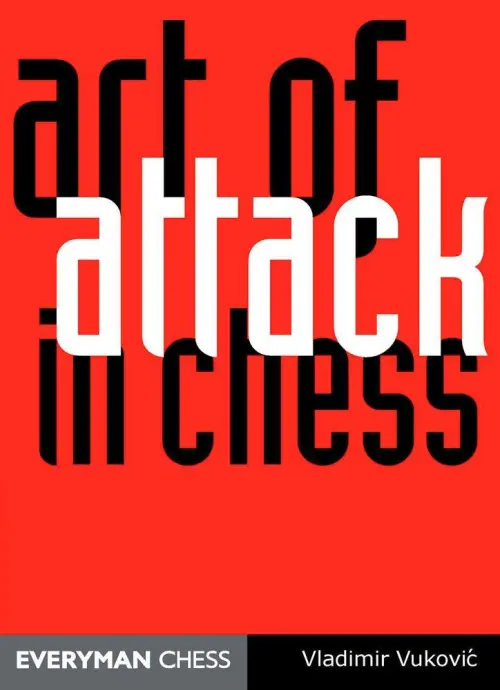
Vuković’s The Art of Attack in Chess is the canonical systematic treatment of attacking the king, and the only book here with a confirmed recommendation at both club and advanced level. Everyman Chess, around 350 pages, algebraic notation.
It explains rather than drills: there is no exercise program, and it is structured as a reference to consult as much as a book to read straight through. That is what separates it from Gormally and Aagaard below. It is recommended on a high-depth review by John Watson in The Week in Chess, plus community discussion across six origins.
Read this record carefully if you are buying secondhand: it covers the first algebraic edition of 1998, not the descriptive-notation original of 1965. Criticisms of that original do not apply to this edition. The case against the book is not empty, and it comes from the same review.
Watson notes that John Nunn’s corrections to the analysis in this edition are “so ubiquitous, and so often obvious in hindsight” that one starts to wonder “how a book on the attack can have so many tactical oversights.” That reassurance — that readers should not conclude the analysis was “especially unsound” — is Nunn’s own, and Watson quotes it only to answer it: not especially unsound for Vuković’s day, he concludes, but it certainly would be now — and he recommends the book all the same, putting its useful range at about 1500 to 2200.
No source calls the book superseded as a systematic treatment, and the remaining objections were vague, edition-unpinned remarks that the posters themselves discounted.
Attacking Chess for Club Players — Herman Grooten
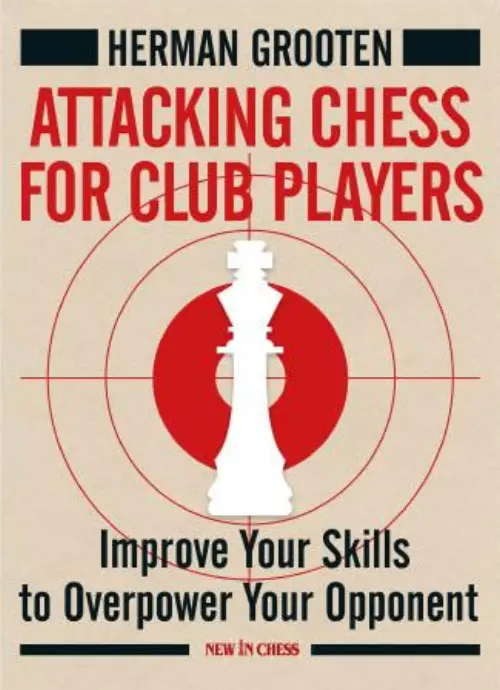
Grooten’s Attacking Chess for Club Players is the structured club-level course. New In Chess, 2016, 352 pages.
It teaches attacking method in prose and includes a dedicated chapter on training skills, which makes it a manual rather than a puzzle collection. It clears at club level on one genuinely independent high-depth review, from US Chess, together with real community discussion.
It is not recommended at advanced level, and it is worth saying why. Seven named-reviewer endorsements that circulate for this book are all publisher blurbs from a single New In Chess product page, each carrying a mid-sentence ellipsis: Sadler, Lane, Schuh, Wainscott, CHESS Magazine, Donaldson and Swinkels.
The advanced case rested almost entirely on them, so it does not stand. Readers also disagree about its level: one places it comfortably with intermediates, another groups it with Vuković and Aagaard as relatively demanding.
Attacking Strategies for Club Players — Michael Prusikin
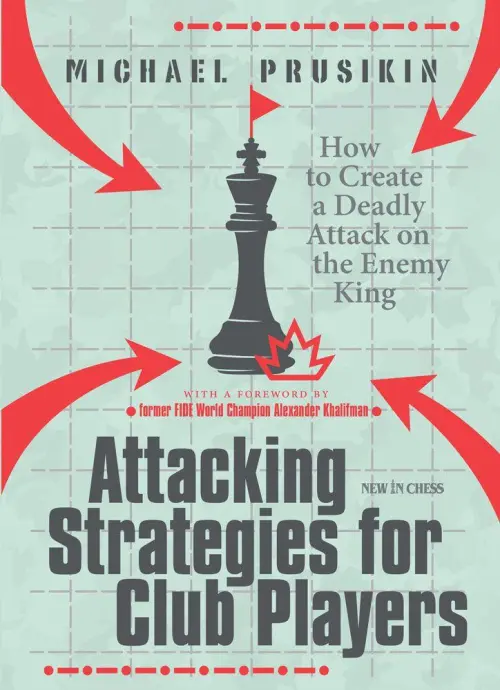
Prusikin’s Attacking Strategies for Club Players is the short, recent option, aimed by its author at players rated 1500–2300. New In Chess, 2021, sixteen thematic chapters in under 200 pages, with a foreword by Alexander Khalifman.
This book is included on thinner evidence than the others in this section, and it should be read as a supplement rather than a first choice. No high-depth independent review of it survived checking. The substantial one is by FM James Vigus, writing on lichess. Three named-magazine quotations turned out to be publisher blurbs from a single New In Chess page, and Khalifman’s endorsement was set aside because he wrote the book’s foreword, which makes him an interested party rather than an independent voice.
What remains is a modest amount of genuine reader agreement. That is enough to mention it, not enough to rank it alongside Grooten or Vuković.
Mating the Castled King — Danny Gormally
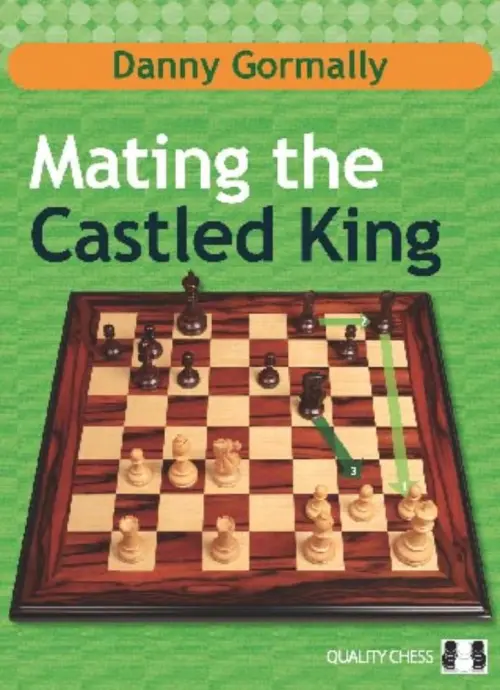
Gormally’s Mating the Castled King is target-specific: attacking the king that has already castled. Quality Chess, 2014, 336 pages.
It is instruction-led but built around a large embedded pattern set, which makes it the drilling option at this level. Its confirmed recommendation is at advanced level, on a high-depth review by Sagar Shah; its inclusion here at club level rests on volume across five origins rather than a high-depth positive review, so treat it as a stretch purchase.
One complaint is worth knowing before you buy, and it is corroborated across independent sources: the puzzles do not always lead to a forced mate, and some admit more than one valid solution. That points mainly at Chapter 2, “160 Mating Finishes,” which is the bulk of the book, and to a lesser extent at Chapter 7.
The most detailed professional review raises it too: NM Sam Copeland, writing on chess.com, reports “some frustrating alternate solutions” and gives an example where the book’s stated answer is not the only one that works. His review is mixed overall — he calls the examples excellent and novel, but judges that “the book bounces around from topic to topic without a compelling sense of purpose.” None of that cancels the recommendation, but for a club player using the puzzles to self-test, it matters.
Chess Secrets: Great Attackers — Colin Crouch (games rather than a course)
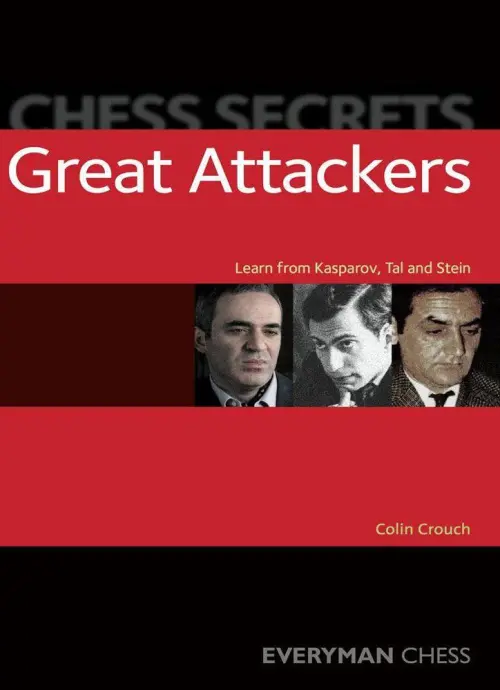
Crouch’s Chess Secrets: Great Attackers is a game collection, not a systematic program. Everyman Chess, 2009. It teaches attacking play through the games of recognized attacking players rather than by building a method chapter by chapter, which is why it sits apart from the manuals above rather than competing with them.
The professional evidence for it is strong across six origins, including Kavalek in the Washington Post, John Donaldson and Dennis Monokroussos. Most of those quotes were gathered from a single retailer’s aggregation page rather than read at their original outlets, though the Kavalek line was confirmed independently. Almost all of it is level-unspecified, so only the club slot carries a level-tagged positive. One mixed review, in Chess Horizons, is preserved as genuine.
One caveat about the shape of the praise: several positive notices commend the games as entertaining rather than the book as instructional. Those are different claims, and if you want a teaching text you should weigh them accordingly.
Zlotnik’s Middlegame Manual — Boris Zlotnik (a broader book with attacking chapters)
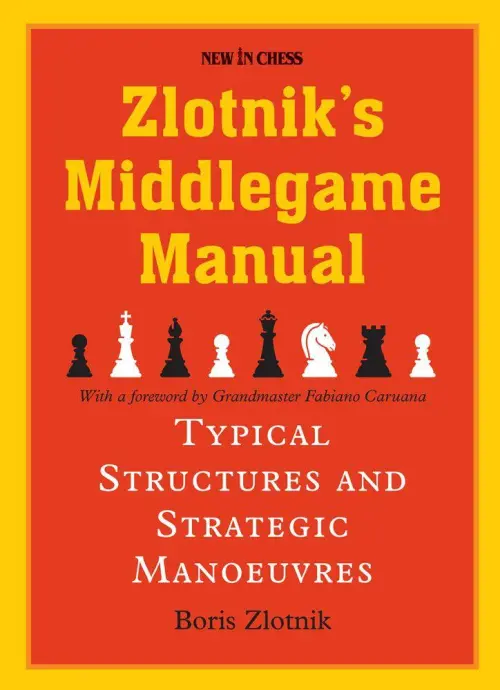
Zlotnik’s Middlegame Manual is a general middlegame manual that earns a place here on specific attacking sections, not as an attacking book. New In Chess, 2020, 400 pages, with a foreword by Fabiano Caruana.
Its attacking content is real and locatable: a kingside attacking plan against the isolated queen’s pawn, and two further sections covering kingside attacks with same-side castling and with opposite-side castling. Those sections are recommended on three attack-specific high-depth observations by FM Richard Webb in British Chess News.
Two limits are worth stating. General praise for the book as a middlegame manual does not transfer to its attacking chapters, and was excluded from that judgment. And community discussion of the book contains nothing attack-specific at all — the coverage exists, but readers rarely talk about it. Buy it as a middlegame manual whose attacking sections are a genuine bonus, not as a book about attacking.
Best attacking chess books for advanced players
At advanced level the set divides by working method. Sokolov’s Sacrifice and Initiative in Chess is the best-evidenced book in this guide; Aagaard’s Attack & Defence is the hardest and the most exercise-driven; Vuković remains the systematic reference; Gormally is narrowly focused on one target.
Sacrifice and Initiative in Chess — Ivan Sokolov
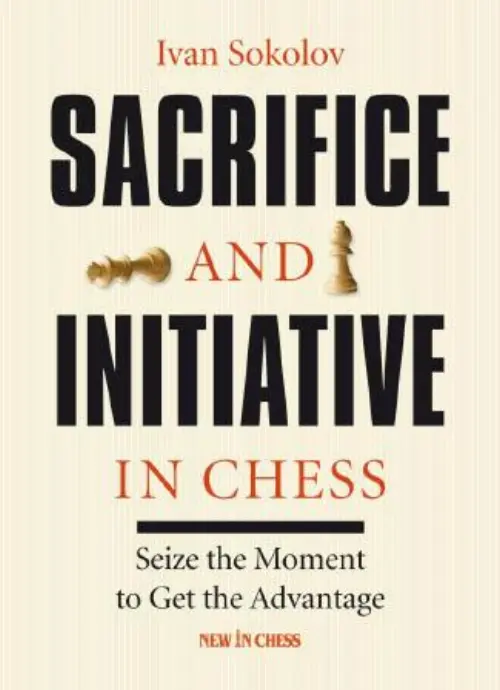
Sokolov’s Sacrifice and Initiative in Chess is the strongest-evidenced recommendation in this guide. New In Chess, 2013, 256 pages. It carries eight high-depth positive notices, including a shortlisting for the English Chess Federation Book of the Year — confirmed directly against the ECF’s own published judges’ text.
Its structure is worth stating precisely. The book’s own contents run Part I, Initiative, chapters 1 to 7, and Part II, Sacrifice, chapters 8 to 16. The sacrifice material is more than half its chapters.
It is not recommended for club players despite the weight of positive comment. The only source that argues its level in any detail, Chessentials, argues against club-level fit, while the counter-claim of a wide audience is a single unelaborated line. Two observations place it above club level. Note also that six professional endorsements for this book all trace back to one retailer’s aggregation page, so the apparent breadth of professional praise is narrower than it looks.
Grandmaster Preparation: Attack & Defence — Jacob Aagaard
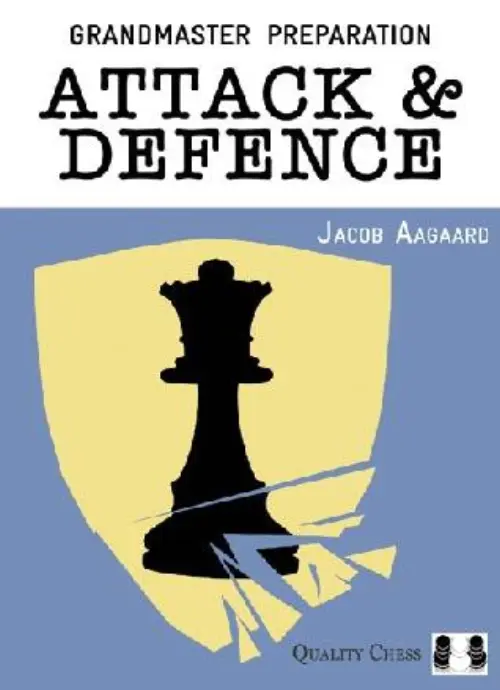
Aagaard’s Grandmaster Preparation: Attack & Defence is the exercise workbook, and the hardest book in this guide. Quality Chess, 2014, around 300 pages.
It is recommended at advanced level on positive evidence across several origins, one of them a high-depth review. Only its attacking half is assessed here — the first eight of its thirteen chapters. The remaining chapters come with the book, but were not assessed for this guide.
If you want to be told how attacks work, this is the wrong book; if you want to be set positions and made to work them out, it is the most demanding option here.
The Art of Attack in Chess at advanced level — Vladimir Vuković
Vuković appears in the club section above, and it is the one book in this guide whose recommendation at both levels is confirmed. What changes at advanced level is how you use the canonical treatise: as a reference to consult on a specific attacking formation, rather than as a book to work through.
Its systematic, indexed structure supports that. It also carries part of this guide’s coverage of defending against an attack — Chapter 10 is “Defending against the attack on the castled king.”
Mating the Castled King at advanced level — Danny Gormally
Gormally’s confirmed recommendation sits here rather than at club level, on the high-depth review by Sagar Shah. At this strength its narrow focus is the point: it works one target — the castled king — in depth, through a large body of pattern material.
The same caveat noted in the club section applies, and stronger players may find it less troubling: some of the puzzles admit multiple valid solutions and do not always end in forced mate.
What this guide does not cover
Three gaps are worth naming, because they are properties of what is available rather than omissions.
Defending against an attack has no dedicated book here. It is covered only inside attacking books — Vuković’s Chapter 10, and the defensive chapters of Aagaard’s Attack & Defence. That is thin by construction.
There is no dedicated book on attacking the king caught in the center, and none on the king hunt. Both subjects appear only as chapters within the books above.
Nothing in this set is recommended for club players on the initiative and dynamic play specifically. Sokolov’s book is the guide’s coverage of that subject, and it is an advanced recommendation.
How were these books chosen?
Every recommendation here rests on sourced, attributed opinion, and the strength of that evidence is not equal across the set. Sokolov and Vuković carry the most independent expert support. Aagaard, Grooten and Zlotnik each rest on one or two named high-depth reviews. Prusikin, and Gormally’s appearance at club level, rest on volume rather than a high-depth positive review, and are marked as such above.
Where endorsements turned out to be publisher blurbs, or came from someone connected to the book, they were set aside rather than counted — which is why some books that look widely praised are described more cautiously here than elsewhere.
Frequently asked questions
What is the best book on attacking chess?
For most players, Vuković’s The Art of Attack in Chess is the standard systematic treatment and the most widely recommended, on the strength of independent expert review and consistent reader agreement. For advanced players, Sokolov’s Sacrifice and Initiative in Chess carries the strongest evidence in this guide.
Is The Art of Attack in Chess suitable for beginners?
No. Readers below roughly 1600 to 1800 report The Art of Attack in Chess as too advanced. Start with mating patterns and tactics.
What should I read if I am rated under 1400?
Mating patterns and tactics before attacking theory. Our guide to the best chess tactics books recommends three books for players under 1400.
Which book is most exercise-driven?
Aagaard’s Grandmaster Preparation: Attack & Defence is an exercise workbook and the most demanding option here. Gormally’s Mating the Castled King is built around a large pattern set, though some of its puzzles admit more than one solution.
Is there a book on defending against an attack?
Not a dedicated one among these eight books. The coverage sits inside attacking books: Chapter 10 of Vuković, and the defensive chapters of Aagaard’s Attack & Defence.
Do I need a separate book on sacrifices?
Sokolov’s Sacrifice and Initiative in Chess devotes its second part, chapters 8 to 16, to sacrifice, which is more than half its chapters.
Is there a book on attacking the king in the center, or on the king hunt?
Not a dedicated one among these eight books. There is no dedicated book on attacking the king caught in the center, and none on the king hunt; both subjects appear only as chapters.
Is there a club-level book on the initiative?
Not in this set. Nothing here is recommended for club players on the initiative and dynamic play specifically — Sokolov’s Sacrifice and Initiative in Chess is the guide’s coverage of that subject, and it is an advanced recommendation.
See our guide to the best books on sacrifices here!
Final Recommendations
For club players
- Attacking Chess for Club Players by Grooten — a structured course in attacking play, with written explanations and a dedicated chapter on training skills.
- The Art of Attack in Chess by Vuković — a systematic guide to attacking the king that also serves as a reference for club and advanced players.
- Mating the Castled King by Gormally — a book for practicing attacking patterns against a castled king. The case for recommending it to club players rests on reader feedback rather than an in-depth positive review, so consider it if you want a challenge.
- Attacking Strategies for Club Players by Prusikin — a concise manual aimed by its author at players rated 1500–2300. Independent support for this recommendation is limited, so consider it as supplementary reading.
- Chess Secrets: Great Attackers by Crouch — a game collection for readers who enjoy studying attacking play through the games of accomplished attackers.
- Zlotnik’s Middlegame Manual by Zlotnik — a broader middlegame manual with sections on kingside attacks when the kings have castled on the same side or on opposite sides.
For advanced players
- Sacrifice and Initiative in Chess by Sokolov — a study of the initiative and sacrifices, with chapters 8–16 devoted to sacrifices. It has the strongest support from the reviews assessed for this guide.
- Grandmaster Preparation: Attack & Defence by Aagaard — an exercise workbook for players seeking demanding practice, and the most challenging book in this guide. Our assessment covers its first eight chapters, which focus on attack.
- The Art of Attack in Chess by Vuković — a systematic reference for revisiting specific attacking formations and the ideas behind them.
- Mating the Castled King by Gormally — focused study and practice in attacking the castled king, recommended at this level on the strength of Sagar Shah’s detailed review.

- Best Dutch Defense Books: Complete Guide - October 31, 2026
- Book Review: The Lighter Side of Chess: Volume 1 - October 29, 2026
- Best Pirc and Modern Defense Books: Complete Guide - October 25, 2026