
“In order to improve your game, you must study the endgame before everything else.” – José Raúl Capablanca.
What is 100 Basic Endgames You Must Know about?
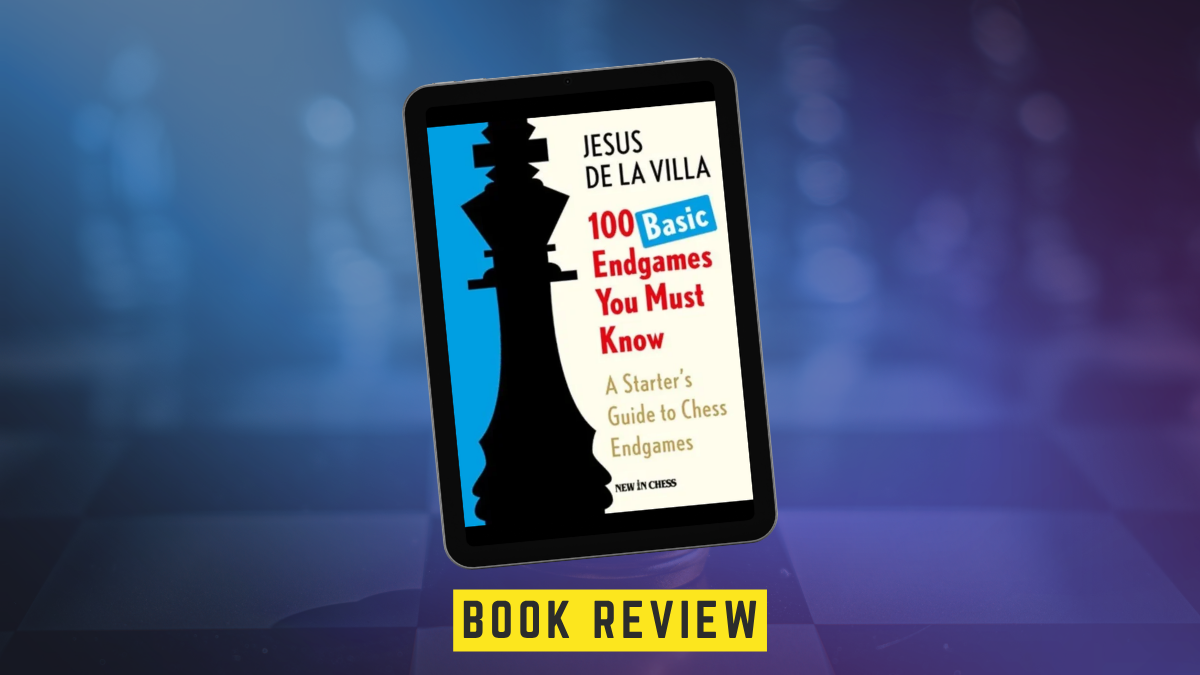
100 Basic Endgames You Must Know by GM Jesus de la Villa (New in Chess, 2026) is a beginner’s endgame course: the 100 most basic and most useful endings a club player needs, starting from mating the lone king. It is the simpler, starter companion to his bestselling 100 Endgames You Must Know, written for players with little or no endgame study. Each chapter classifies its endings by complexity (in Elo bands) and by practical usefulness, adds statistics on how often each ending occurs and how players score with it, and the book closes with 92 graded test positions and detailed solutions. It runs to 248 pages at beginner level.
GM Jesus De la Villa is the author of several endgame books, including his well-known 100 Endgames You Must Know, now in its 6th edition.
100 Basic Endgames You Must Know follows the format and style of his previous endgame books, and it is aimed at players with less experience in endgames.
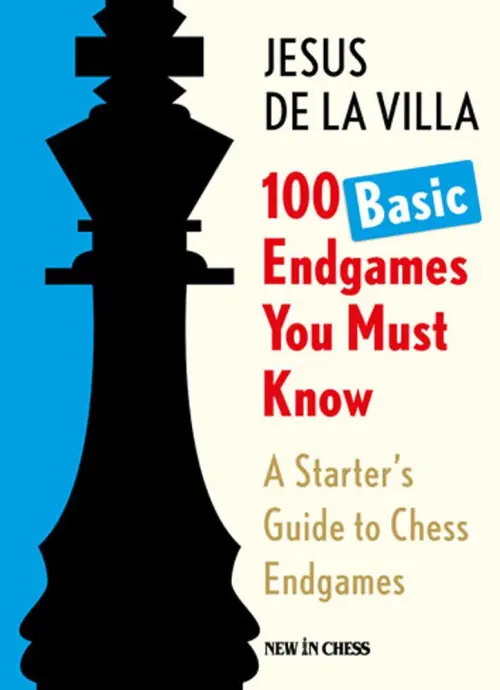
Which book is this? Not the famous 100 Endgames You Must Know. This is a simpler, earlier-stage companion, written for players who found that book too advanced or who have never studied endgames. If you already handle basic theoretical endings comfortably, the original is the more appropriate book.
De la Villa comments about his reasons for writing the current book as follows:
“A frequent suggestion is that [100 Endgames You Must Know] could have been simpler. In fact, when I put it together, it was my intention that it should be simpler than the ones I had studied, but clearly it is very advanced for those who are just starting out in the world of chess, or who have never studied endgame theory.
From those considerations, and at the suggestion of my editor, who also thought that it was a good idea, there has emerged the need to make this new book, in which I’m attempting to compile the 100 most basic endings which are at the same time the most useful in practice.”
Regarding the content of the book, the author writes:
“Most of the endings we are going to study are very basic. They are ones that an experienced player can handle, or should be able to handle, with ease, and which are essential to know, in order:
1) not to suffer continual disappointments through being unable to exploit advantages accumulated in the middlegame; and
2) more importantly, not to face the simplification stage with uncertainty.
This book is the basic endgame survival kit.”
What’s Inside – Contents
17 chapters, closing with a basic-level exercise set · 248 pages
| Introduction | |
| Chapter 1 | Mating the lone king |
| Chapter 2 | The struggle between two lone queens |
| Chapter 3 | The battle of the pieces with no pawns |
| Chapter 4 | Pawn endings: king and pawn vs king |
| Chapter 5 | King and two pawns against king |
| Chapter 6 | Pawn endings: blocked pawns |
| Chapter 7 | Pawn endings: passed pawns |
| Chapter 8 | Pawn endings: advanced concepts |
| Chapter 9 | Queen vs pawn |
| Chapter 10 | Minor piece and pawn against lone king |
| Chapter 11 | Fortresses |
| Chapter 12 | Rook against pawns |
| Chapter 13 | Minor piece against pawn |
| Chapter 14 | Rook endings |
| Chapter 15 | Opposite-coloured bishops |
| Chapter 16 | Bishops of the same colour |
| Chapter 17 | Exercises – basic level |
| Colophon | |
As can be seen from the Table of Contents above, the book starts with the basic task of mating the lone king, and how this can be done easily and efficiently. Interestingly, the checkmating technique with a bishop and knight is not covered, presumably because it is too complicated for beginners.
One scope note. The book deliberately leaves out the bishop-and-knight checkmate, presumably as too complex for a beginner audience. If you want that particular technique, you will need another source.
The author has included some key features in the book that enhance its use as a teaching tool. Each chapter starts with an introduction to the material to be covered, and conclusion sections are included as appropriate to summarise the contents of the chapters. Another important feature of the book is the inclusion of suggested Elo ratings and levels of usefulness of the examples. He writes:
“Each chapter opens with a very brief introduction, to put us in the right frame of mind to begin. In it, I classify the level of complexity and usefulness of the endings in that chapter. I shall divide the level into Low (up to 1000 Elo rating), Medium (between 1000 and 1500) and High (above 1500), but in some cases there is a further assessment. The usefulness is Maximum (when it is not possible to play without knowing these positions), High (when you are going to come across them frequently or when they are necessary in order to understand others), Medium (when you will normally encounter them only occasionally) and Low (when they don’t occur often but are useful in order to have an overview of endgame theory and to facilitate the study of other endings in the future).”
Each chapter uses the above classifications to categorise the examples in the chapter, so that readers can focus on the essential examples in a first reading of the chapter and later expand their knowledge of the material as needed.
The book includes statistics on how common each ending is and how players performed (win/loss/draw) when playing the endings in practice. The final chapter contains 92 test positions for readers to solve. These are split into four levels, and detailed solutions are given.
As expected from the author, the annotations in the book are very well done and contain a good balance of verbal and analytical commentary.
Two examples from the book are given below, with annotations from the book.
The author introduces the first example as follows:
“In the struggle of rook against pawn, there is one position (or three ‘twin’ positions, as we understand it) which makes the calculation much easier, and which is reached in a large number of cases…
The result in this easy-to-remember position has no exceptions (although there are a few different manoeuvres, according to the file where the pawn is situated). That’s why it’s so useful to understand it well.
The key principle is: if it’s the side with the rook to move, and he can give check with the rook on the file, then he wins. But if it’s the side with the pawn to move, then it’s a draw.”
The author shows that the position is a draw if Black moves first. The two drawing moves are 1…b2 and 1…Kc2.
The next example is the Level 2 Exercise 18 from the game Kupreichik – Sulskis, Minsk 1996. The question is: How can Black save the game?
In conclusion, this is an excellent teaching text on endgame theory. Readers who master the material will have a solid background in the treatment of theoretical endgames. As the author notes, this knowledge will never go out of date, unlike opening theory that is constantly evolving. The book can therefore be recommended to all players in the target audience.
What’s Inside – Forward Chess Ebook
- The essential theoretical endings — from mating the lone king upward, the 100 endings the author judges most basic and most useful in practice
- A complexity rating per ending — Low (up to 1000 Elo), Medium (1000–1500) and High (above 1500), so you can match study to your level
- A usefulness rating per ending — Maximum, High, Medium or Low, flagging which positions you cannot play without
- Chapter introductions and conclusions — each chapter is framed and summarized as a teaching unit
- Practical statistics — how common each ending is, and how players actually score (win/loss/draw) when it occurs
- 92 test positions — a closing chapter of exercises split into four levels, with detailed solutions

- Best Pirc and Modern Defense Books: Complete Guide - October 25, 2026
- Best Italian Game Chess Books: Complete Opening Guide - October 20, 2026
- Best Books on the English Opening: A Complete Guide - October 15, 2026