
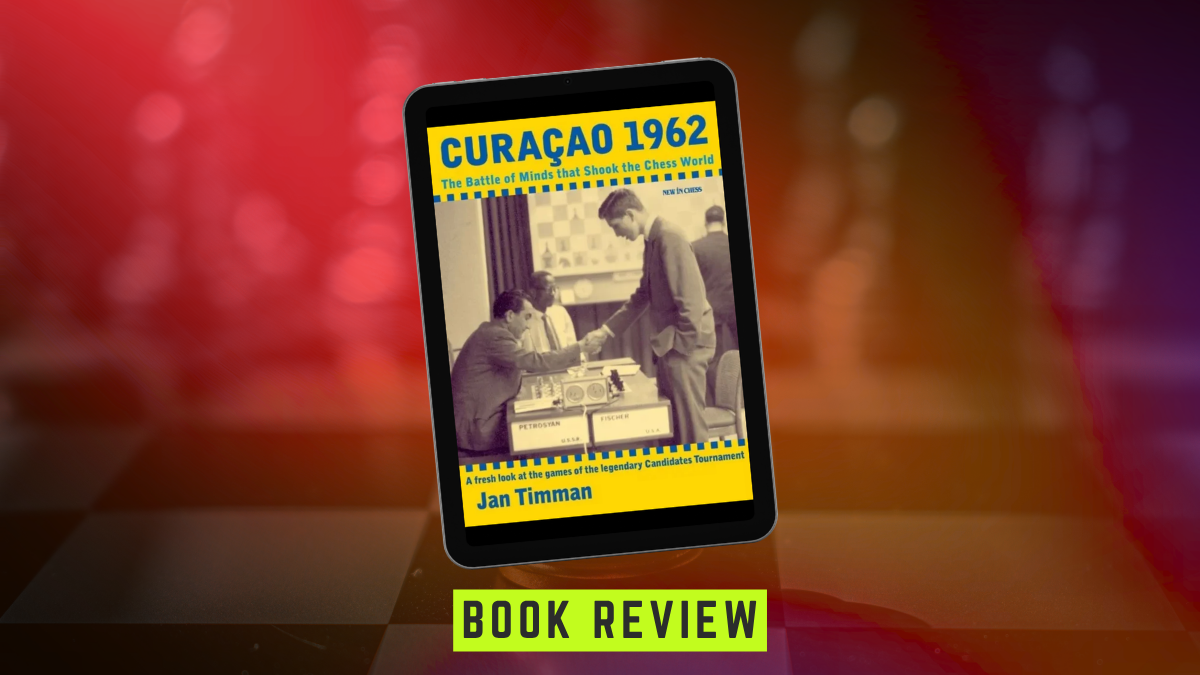
“The Russians have fixed world chess.” – Bobby Fischer after his disappointing result in Curaçao.
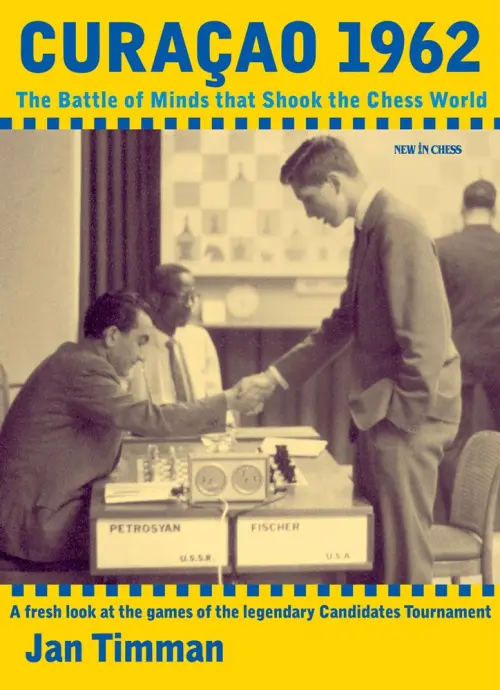
Curaçao 1962 is Jan Timman’s account of the 1962 Candidates’ Tournament, the Cold War contest where a 19-year-old Bobby Fischer accused three Soviet players of arranging draws among themselves. Timman narrates the event, weighs the collusion charge, and annotates the key games, including 16 of Fischer’s. Listed at intermediate level, it reads well for anyone drawn to chess history and the great tournament books.
The eight-player Candidates Tournament in Curaçao, 1962, was full of high drama and intrigue. This is indicated by the subtitle of this book: The Battle of Minds that Shook the Chess World.
The idea of this book arose during the preparations for the 40th anniversary of the tournament in 2002. The book was written by GM Jan Timman, who sadly passed away recently in February 2026, and it was originally published in 2005. Timman, a world-class player, former world number 2, and an excellent author, was an ideal choice for the book.
Tigran Petrosian won the tournament by a mere half point from Paul Keres, the eternal second, and Efim Geller. He would go on to successfully win the 1963 World Championship match against Mikhail Botvinnik. Timman quotes Petrosian’s successor, Boris Spassky, who succinctly said:
“He set himself the aim of becoming World Champion, and he achieved it.”
It was an exceptionally strong tournament, with three players, Petrosian, Mikhail Tal and Bobby Fischer, holding the World Championship title at some stage of their careers. The tournament was a gruelling affair of 28 rounds over nearly two months, and it had a one-week break in the middle of the tournament. It’s hard to imagine such a format in today’s fast-paced chess world!
While the tournament produced some excellent games, the drawing pact between three of the Russian players, Petrosian, Keres, and Geller, was the major talking point of the tournament, and Timman covers this issue in the book. The three players drew all their games against each other. The other Russian players, Tal and Viktor Kortchnoi, appeared not have been part of the pact, although doubts remain about Kortchnoi’s role. Timman writes:
“The rumours that Kortchnoi was in some way involved in the combine are still going around. A Russian former World Champion once told me that Kortchnoi had been told to lose his game as Black against Petrosian in Round 23. Petrosian’s wife Rona supposedly put great pressure on Kortchnoi’s wife Bella, and it is a telling detail that both women were Armenian. In New In Chess 2003, Issue 1, Kortchnoi observes in an interview with Dirk Jan ten Geuzendam: ‘I would say that the part played by my wife in this situation should not be underestimated. She was Armenian and in some ways she behaved like Petrosian’s youngest sister… When Petrosian was around, she always acted like a pupil, like a younger sister.’”
Fischer used the Keres – Petrosian game from round 24 in his claims against the Russians.
Fischer stated that Petrosian was winning in the final position, and Timman offers some analysis to conclude that he agrees with Fischer.
Fischer’s charges against the Russians ultimately led him to withdraw from the world championship cycle until the Sousse Interzonal in 1967, where a dispute with the organisers led him to leave the tournament even though he was leading at the time of his withdrawal. However, his complaints after Curaçao played a role in FIDE adopting Candidates matches for the next world championship cycle.
The other major incident in the tournament was Tal’s illness, temporary hospitalisation and ultimate withdrawal from the tournament. The book includes a photo of Fischer visiting him in hospital and playing a friendly game with him. Timman notes that none of the other players visited Tal in hospital.
As expected, Timman’s game annotations are excellent and incisive. He also corrects and updates some previous analysis, including analysis by Kasparov. He is also not above self-criticism and corrects some of his own previous faulty analysis. While he uses chess engines to help with the analysis, especially in highly tactical positions, he doesn’t overwhelm the analysis with such engine output. Some of the games are only lightly annotated, especially the short draws. Timman also notes how some of the openings used in the games developed after the tournament by quoting later games where appropriate.
The book is complemented by a fine selection of photos, player profiles, both at the time of the tournament and in their later careers, and an Epilogue that summarises the tournament.
Two examples from the book are given below, with annotations from the book.
The following game was suspected of being deliberately lost by Kortchnoi.
At the end of this game, Timman writes:
As I wrote earlier (in chapter Combine), people speculated that Kortchnoi had lost this game on purpose, and it is true that, at the first glance, the course of the game would justify such dark suspicions.
In reality, however, games in which one of the players has been bribed — although bribery isn’t even the correct word here, as no money had changed hands — look quite different. A well-known example is Taimanov-Matulovic, Palma de Mallorca 1971. Matulovic would get 400 dollars if he lost; he arrived late in the playing-hall, played rapidly and poorly and read the newspaper in between moves. It is an entirely different thing to be beaten so painfully and comprehensively as in this game between two rivals who, in principle, had the beating of each other.
I also think that this is not the only reason why we needn’t doubt Kortchnoi’s words (viz. that he had not understood the opening system properly). Strangely enough, he occasionally met with similar catastrophes in his later career, for example when he lost in 18 moves against the Spanish master Ricardo Calvo during the Havana Olympiad of 1966.
Of course, it’s worth noting that Petrosian and Kortchnoi became bitter enemies in their later careers.
In conclusion, Timman has produced an excellent book on an important historical tournament that included some excellent games and controversies that caused major changes in the chess world. Timman’s clear analysis and excellent background commentary make this an excellent book for players of all levels to enjoy and study.

- Best Books on Chess Sacrifices: 6 Essential Reads - October 11, 2026
- Book Review: My First Chess Opening Repertoire - October 1, 2026
- Best Books to Study the Sicilian: A Complete Guide for White - September 18, 2026