
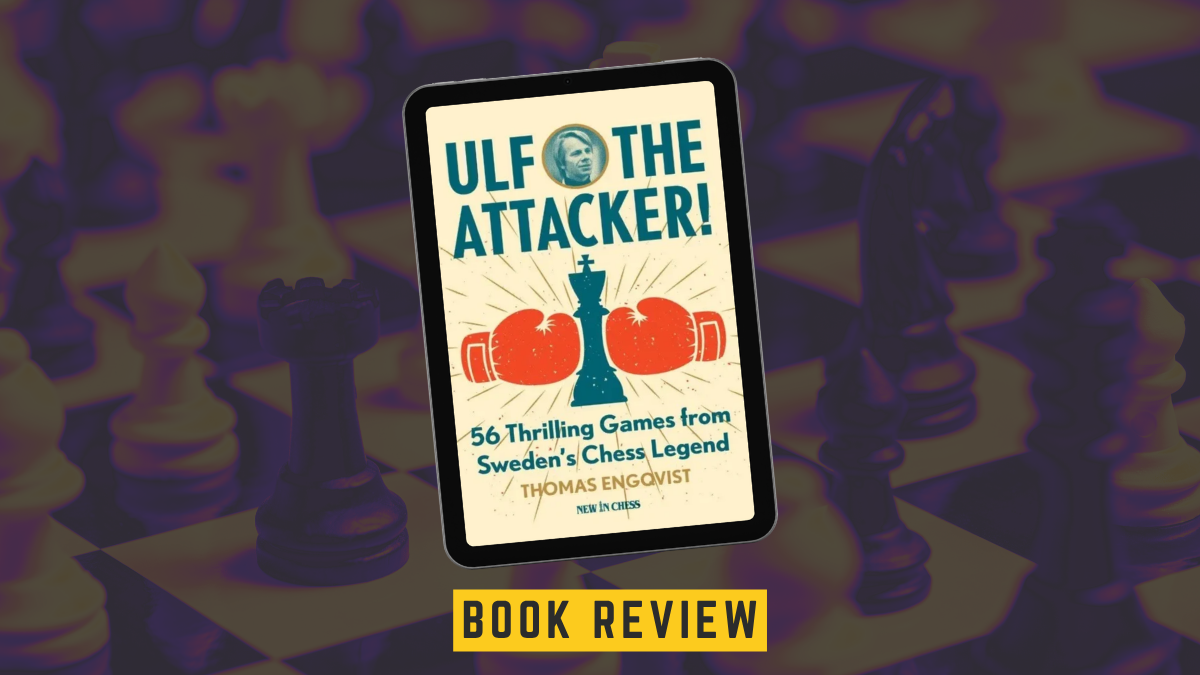
What is Ulf – the Attacker! about?
Ulf – the Attacker! by International Master Thomas Engqvist (New in Chess) is a game collection built around an overlooked side of Swedish grandmaster Ulf Andersson: his attacking play. Andersson reached fourth in the world in 1983 and is remembered for positional control and endgame technique, but this book gathers 56 annotated games and 16 game fragments in which he went after the king instead. The games run chronologically across four parts, from his junior years through his peak and beyond, and the annotations are computer-checked throughout. It is written for intermediate players and above who want to study attacking chess through a complete career rather than a themed manual.
Book Review: Ulf – the Attacker! by IM Thomas Engqvist
– GM Jan Timman in his book The Art of Chess Analysis.
The association of Ulf Andersson with an attack does not usually spring to mind when thinking about the elite Swedish grandmaster. The former world number four is usually known for playing in a very solid style, particularly in his later career.
The late GM Jan Timman wrote in his Forward as follows:
After the Reykjavik tournament [1972], Ulf gradually started playing more cautiously, with a wary eye for danger. He played tennis in the same way, always from the baseline.”
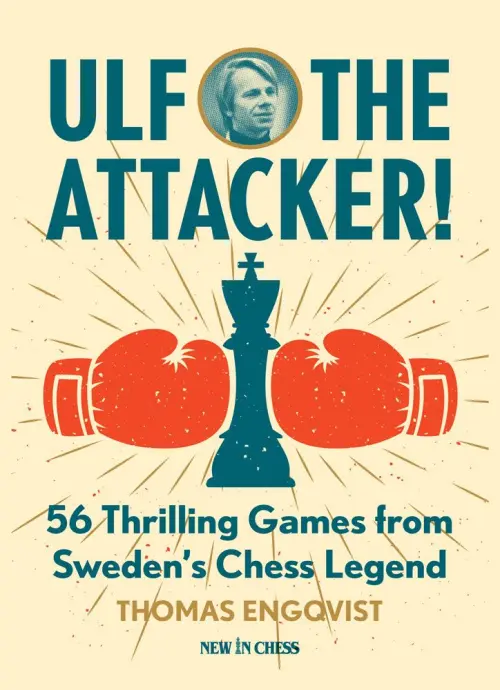
What’s Inside – Forward Chess Ebook
Four chronological parts covering 1967 to 2018 · 56 games and 16 game fragments · 278 pages
| Foreword by Jan Timman | p. 7 |
| Preface | p. 9 |
| Introduction | p. 18 |
| Part I — From beginner to Swedish Champion (1964–1969) | p. 23 |
| Part II — From professional to International Grandmaster (1970–1972) | p. 77 |
| Part III — Raising the bar towards becoming one of the best players in the world (1973–1983) | p. 125 |
| Part IV — Transition from peak rankings post-1983 | p. 175 |
| Index of openings | p. 275 |
| Index of names | p. 276 |
What you actually get. 56 fully annotated games plus 16 shorter game fragments, spanning 1967 to 2018, with every annotation computer-checked. Losses are included alongside the wins, which Engqvist frames as necessary to show the risk that attacking chess carries.
As the Table of Contents above shows, the book discusses Andersson’s career in chronological order based on 56 games plus 16 game fragments, including some of his losses, and a selection of photos. The author of the book is another Swedish International Master, Thomas Engqvist, who has been able to access a lot of commentary and background material on the games that is not easily accessible to non-Swedish speakers. This material includes many of Andersson’s comments on his games and the background to them.
A note on the selection. Engqvist deliberately leaves out the games Andersson is best known for, the deep opening preparation, the positional squeezes and the endgame technique. Readers coming to this expecting the standard Andersson canon will not find it here. That omission is the whole point of the book, but it is worth knowing before you buy.
Engqvist comments on his choice of games as follows:
Ulf in an attacking mood, where his main focus was attacking the king, is an often overlooked and underestimated dimension of his play. It is clear that someone who ascended to the world chess elite with attacking games and maintained his position for so many years, and needing just two tournaments to become the highest rated player ever in correspondence chess, is skilled in both the strategic and tactical aspects of the game.”
The author also highlights perhaps Andersson’s most famous game against then World Champion Anatoly Karpov in Milan, 1975, and he writes:
Andersson has himself written:
The author has used a good balance of verbal commentary and variations when analysing the games, and this helps readers to absorb the material. While it’s clear that the author respects and admires Andersson, he is still objective when it comes to the analysis of his games. He readily notes cases where Andersson missed chances or played poorly. This is an admirable approach and provides a much more realistic picture of Andersson’s games. Engqvist also updates and corrects previous analysis of the games. Of course, as would be expected from a modern book, all the analysis has been computer-checked to ensure that the analysis is fundamentally sound and doesn’t contain errors.
The book also gives a great insight into Andersson’s warm personality and love of chess. Andersson has written:
Where to begin. Engqvist singles out Karpov-Andersson, Milan 1975 (Game 25) as the game that best captures Andersson’s style, and offers Andersson-Portisch, Skopje 1972 (Game 24) as a teaser for the rest, a Morphy-flavored game where the bishop lands on a3 with decisive effect.
Two examples from the book are given below, with annotations from the book.
In conclusion, this is an excellent collection of attacking games from the Swedish GM. It also has a lot of interesting biographical material and insights into Andersson’s thought processes during the games. Therefore, it’s easy to agree with GM Timman when he wrote:

- Best Pirc and Modern Defense Books: Complete Guide - October 25, 2026
- Best Italian Game Chess Books: Complete Opening Guide - October 20, 2026
- Best Books on the English Opening: A Complete Guide - October 15, 2026