
“The opening is a fight for the initiative.” – Emanuel Lasker.
What is My First Chess Opening Repertoire about?
My First Chess Opening Repertoire by IM Christof Sielecki is a compact opening repertoire for both White and Black, aimed at beginners and improvers. White plays 1.e4, with the Four Knights against 1…e5 and the Alapin against the Sicilian. Black plays the Sicilian Four Knights against 1.e4 and the Tarrasch Defense against 1.d4, with related setups against 1.c4 and 1.Nf3. Short chapters explain the opening choices, while a final chapter of model games shows how play continues into the middlegame.
IM Christof Sielecki has written several opening books for White and Black in his “Keep it Simple” series. In this book, he uses the same approach for a single-volume opening book for both sides. In a sense, this is a simpler and less-detailed repertoire than the repertoires in his other books. However, this is reasonable as the book is designed as a first repertoire that can be expanded later.
Sielecki writes:
“What do you need to master the opening phase of the game successfully?
It all depends on your playing level and your experience. If you have only recently started playing chess or are looking for a compact start in the world of openings, this book is for you. It covers a repertoire for both colours, focusing on the most essential information. After studying the book, you will know how to open the game with White, playing the most popular move 1.e4. This book provides you with all you need to know to put pressure on your opponents. With Black, we need to be ready for the opposite scenario. We must anticipate what White may throw at us and prepare reliable and active counterpunches. We will study how to confidently battle1.e4, 1.d4 and other first moves.”
The author’s approach is consistent with the advice of the outstanding Hungarian GM Lajos Portisch who wrote:
“Your only task in the opening is to reach a playable middlegame.”
The chosen variations are based on the likelihood of meeting them in your games. The author writes:
“For both sides, the emphasis is on moves you will usually face at the beginner and post-beginner levels. Therefore, we have the most detailed coverage of 1.e4 e5 for White (occurs approximately 50% of the time) and 1.e4 c5 for Black (occurs approximately 70% of the time).”
The repertoire at a glance
White starts with 1.e4. Black’s repertoire covers 1.e4, 1.d4, and other first moves.
| Position | Sielecki’s choice |
|---|---|
| White against 1…e5 | Four Knights |
| White against 1…c5 | Alapin Variation of the Sicilian |
| White against other defenses | Coverage of the other major replies to 1.e4 and some less common lines |
| Black against 1.e4 | Sicilian Four Knights, with coverage of White’s alternatives |
| Black against 1.d4 | Tarrasch Defense |
| Black against 1.c4 and 1.Nf3 | Related setups based on the Tarrasch repertoire |
Sielecki’s White repertoire is similar to the repertoire in his book Keep it Simple: 1.e4, and it focuses on the Four Knights Variation as the main battleground after 1.e4 e5. Of course, he also covers the other major defences after 1.e4 as well as some of the less-popular lines.
The repertoire for Black is somewhat unusual for a first repertoire. Sielecki recommends the Sicilian Four Knights against 1.e4 and the Tarrasch Defence against 1.d4, with similar lines against 1.c4 and 1.Nf3.
Regarding his choice of the Sicilian Defence, Sielecki writes:
“Why are there so many tough lines after 1. e4 e5? A key reason is the weakness of f7, demonstrated in openings like 1.e4 e5 2.Nf3 Nc6 3.Bc4 Nf6 4.Ng5, when you have to know exactly what to do, otherwise you might lose right out of the opening. We avoid these issues with the Sicilian Defence.”
Similarly, he writes about the Tarrrasch:
“The Tarrasch leads to positions that make it easy for us to develop our pieces, as you will see. We can develop our knights to the natural squares f6 and c6 and have no problems with our bishops. White’s best reply to the Tarrasch is 4.cxd5 exd5, when our light-squared bishop enjoys an open diagonal, too.”
However, he also notes the issue of the isolated pawn positions in the Tarrasch:
“So the huge upside of our opening is quick and easy development – what’s the drawback? There is one, and it is best explained by studying the most popular line at the master level, which is 4.cxd5 exd5 5.Nf3, the topic of our ‘Tarrasch main line’ chapter. In this scenario, we’ll regularly reach a position that features a trade of White’s d-pawn for our c-pawn, leading to an ‘Isolated Queen’s Pawn’ (IQP). This pawn can become a weak spot in Black’s camp, as it can’t be protected by one of its pawn colleagues – it is isolated. White will try to attack this pawn and exert pressure on it. Black argues that the quick and active development and piece play are at least enough compensation for this static liability.”
These comments show that the author is given a balanced view of his repertoire, rather than claiming that his suggestions always lead to an advantage, which is of course nonsense.
The book includes introductory sections that explain why the repertoire choices were made, and these sections help readers to understand the rationale behind the chosen variations. While there are 33 chapters on specific openings in the book, they are generally quite short and easy to understand.
Any book that presents repertoires for both sides inevitably leads to a clash between the two repertoires at some point. In this book, the clash happens in the Alapin Variation of the Sicilian Defence.
In the White repertoire, the author analyses 6…d6 for Black and recommends 7.Bc4, and writes:
“The best development option for our bishop… We should keep more pieces on the board, as the advanced e-pawn might help us to generate an attack on the kingside. Black’s knight is nicely placed on d5, but it no longer defends the kingside. After castling kingside first, a common idea for White is to activate the queen via Qd1-e2-e4 to the kingside.”
Curiously, the author doesn’t mention 6…d6 in the Black repertoire. Instead, he suggests the continuation 6…b6 7.Bc4 Ba6 for Black, and writes:
“I suggest this move, intending to either develop the bishop to b7 or offer a trade by playing…Ba6.”
The repertoire chapters are complemented by a final chapter on model games, and these games show how the repertoire choices can develop after the opening phase. Sielecki provides plenty of verbal and analytical commentary throughout the book to justify his choices and explain the theory of the openings. The commentary is a highlight of the book and helps it from becoming a dry list of deeply-nested variations that can easily confuse readers.
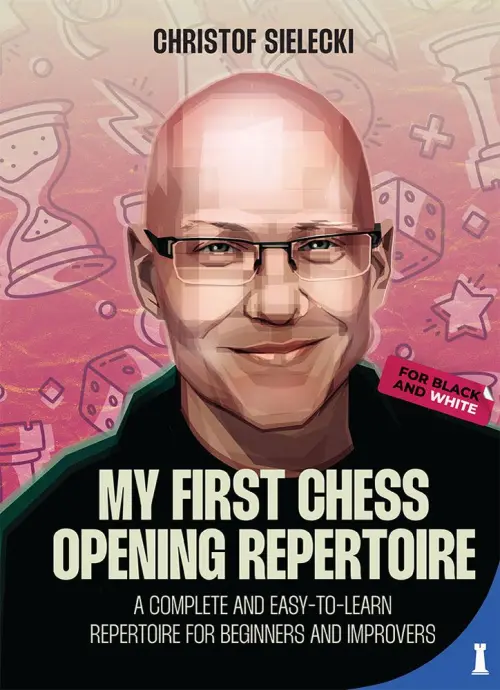
My First Chess Opening Repertoire
A Complete and Easy-to-Learn Guide for Beginners and Improvers
In conclusion, Sielecki has written an excellent book for a first opening repertoire. The suggested variations are sound and lead to playable positions that readers can understand. The level of detail offered is appropriate for the target audience, and the repertoire can be expanded without becoming obsolete. Hence, this is a book that can be recommended to any player who needs a solid and concise first repertoire for both sides.

- Best Pirc and Modern Defense Books: Complete Guide - October 25, 2026
- Best Italian Game Chess Books: Complete Opening Guide - October 20, 2026
- Best Books on the English Opening: A Complete Guide - October 15, 2026