 Ebook
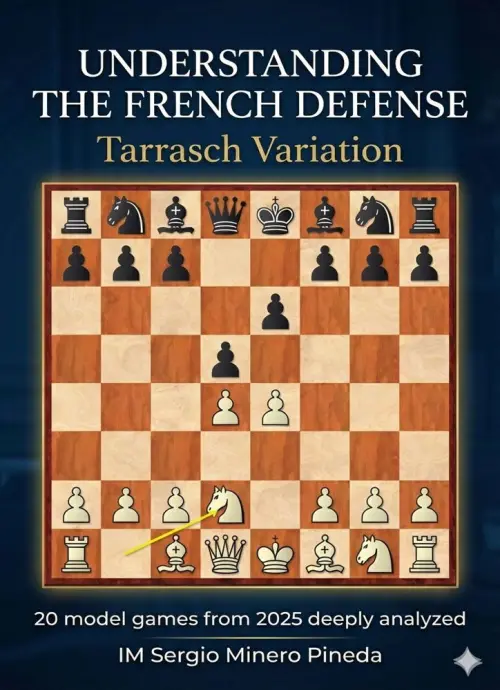
Understanding the French Defense: Tarrasch Variation

If you are reading this, you likely already know the feeling: that unique blend of tension and solidity that comes with playing 1...e6. I have played the French Defense my entire life. It has been my trench, my counter-attacking weapon, and at times, my lifeline in positions where others would have collapsed. I know it intimately, not because I memorized a thousand variations from a database, but because I have suffered and enjoyed its structures over the board, with the clock ticking and adrenaline pumping.
And this is where I want to be brutally honest with you: memorizing variations will not make you a better French Defense player. I see too many students (and even many masters) fall into the trap of "modern theory." They memorize 25 moves of a line recommended by an engine, but the moment the opponent plays a "human" move that wasn't in the file, they go blank. They know the move, but they don't understand the position. This book is not designed for you to memorize; it is designed for you to absorb patterns.
Why Study "Model Games"? Chess is played by analogy. When you are on move 30, in time trouble, your brain doesn't calculate infinite variations; your brain searches its internal archive and says: "This looks like that Radjabov game. The plan here is to break with f6." The 20 games I have selected here are not random. They are the "cream of the crop" of master practice from 2025. They are living battles where the theory of the Tarrasch Variation (3.Nd2) was tested at the highest level.
By studying these complete games, from opening to endgame, you will achieve something that studying isolated variations cannot give you:
– Understanding Transitions: When should you trade the "bad bishop"? When should you accept an Isolated Queen's Pawn (IQP) in exchange for activity?
– Learning to Defend: The French requires nerves of steel. You will see how elite GMs withstand pressure and wait for the exact moment to counterpunch.
– Recognizing Typical Endgames: Many of these duels are decided in rook or knight endgames that recur time and time again.
A Note on Technology (Stockfish and Leela)
To write this analysis, I have used the most advanced technology available. I have consulted the silicon oracles (Stockfish 16 and Leela Chess Zero) to ensure tactical precision. There is nothing worse than a book with calculation errors. However, the engine is merely a quality control tool, not the author. The engine might tell you a position is "+0.45". For a human, that number means nothing. My job here has been to translate that number into human language: to explain why White is better (space, weak squares) or why that advantage is illusory if Black manages to activate their light-squared bishop. I have prioritized human ideas over incomprehensible computer lines. I want you to understand the plan, not memorize binary code.
How to Use This Book
Do not read this like a novel. If you have a physical board, use it. If you are using the ForwardChess screen, pause at critical moments. Try to guess the Master's move before revealing it. Ask yourself: "Why did he reject the queen trade?" or "Why did he sacrifice that pawn?". These 20 games are a treasure map of the modern French. If you study them deeply, the next time someone plays 3.Nd2 against you, you won't be recalling lines; you will be playing with the borrowed experience of the best players in the world. Welcome to the trench. Let’s begin.