
What is Kingwalks: Paths of Glory about?
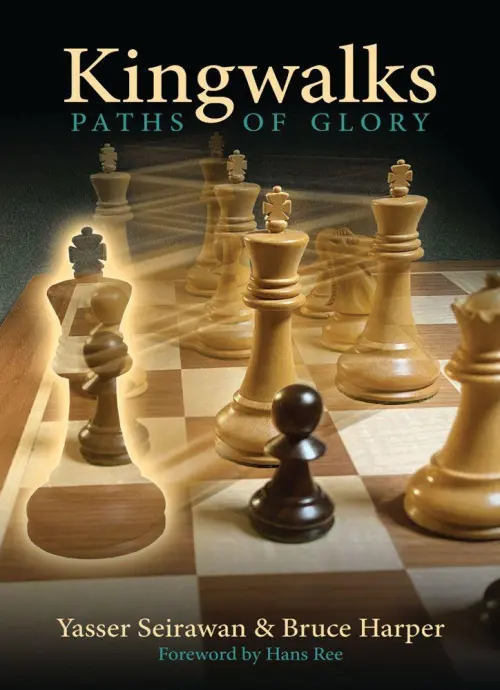
Kingwalks: Paths of Glory by GM Yasser Seirawan and Bruce Harper is a collection of chess games built around one of the game’s most fascinating contradictions: the king voluntarily leaving its usual place of safety. The book examines successful and unsuccessful kingwalks in a wide range of situations, from preparing attacks and defending key points to escaping across the board, opening and endgame kingwalks, double kingwalks, and famous examples from the games of players such as Wilhelm Steinitz, Aron Nimzowitsch, Tigran Petrosian, Duncan Suttles and Seirawan himself.
“The king is a strong piece. Use it!” – Reuben Fine.
We are taught to keep our king safe during the opening and middlegame and only bring it out in the endgame, when it can help the pawns to promote. The king is generally valued between three and four pawns in the endgame, and hence Fine’s advice above is clearly valid in the endgame. However, there have been many games where the king either stays near the centre of the board or leaves its castled position during the opening and middlegame. Of course, this is potentially a risky strategy, and it can lead to either a spectacular brilliancy or an ignominious defeat.
What is a kingwalk?
The authors define a kingwalk as a purposeful and voluntary king maneuver with a strategic or tactical goal. It generally takes place in the opening or middlegame, although the authors also include compelling examples from the endgame. A kingwalk is different from a king hunt: the king is not simply being driven around by an attack, but is deliberately being moved as part of the player’s plan.
Kingwalks by GM Yasser Seirawan and FIDE Master Bruce Harper is a book that is dedicated to examples of the wandering king, and it includes both successful and unsuccessful examples. The authors define the term kingwalk as follows:
“The term “kingwalk” as used in this book refers to a king maneuver with the following characteristics:
• It must be purposeful, in that the king maneuver must have a strategic or tactical goal (although, as discussed above, this goal need not be justified).
• It should be voluntary. A kingwalk may be made under duress, in that it is the only viable defense, but it should still be a deliberate, planned strategy on the part of the player doing it, having anticipated the opponent’s attack, as opposed to an unplanned blasting of the king out into the open.
• It generally occurs in the opening or middle game, as opposed to the endgame (although we have been flexible on this – compelling and clear king maneuvers in endgames have been included).
Kingwalks are therefore clearly (and in some cases, not so clearly) different from “king hunts,” where an attack results in the exposure of the defender’s king. There is also no minimum length for a kingwalk, although naturally the longer the kingwalk, the better. But it is wrong to emphasize this factor too much, just as it’s wrong to say “the longer the combination, the more impressive it is.” A kingwalk of even one or two squares can be compelling. The length of a kingwalk may be a measure of its audacity, but this will depend on the circumstances.”
The Table of Contents above shows the scope of the book. General examples are given in Chapters 1 – 11, while the next five chapters focus on kingwalks during the games by specific players, including one on coauthor Seirawan. Some games by coauthor Harper are also included in the book. Regarding Chapter 16, the authors write:
“At least one of the authors of this book comes by his knowledge of kingwalks honestly. We have already seen some Seirawan games in the previous chapters, but now we will see that kingwalks are common in his games. Whether they are always justified and successful is, of course, a different issue…”
Perhaps the most famous successful kingwalk in recent years was by GM Nigel Short against GM Jan Timman in Tilburg 1991, which is analysed in the book.
The authors do a very good job of analysing the illustrative games with both variations and verbal commentary. They also refer to, and sometimes correct, previous annotations, including some on famous historical games, where appropriate. They acknowledge their debt to previous annotators with some humour:
“Where analysis has been borrowed from other sources, it is acknowledged. Where the authors have used their previously published analyses, we have been less generous. All analytical errors are most definitely someone else’s fault.”
As expected for a recent book, the authors used the current super-strong chess engines to assist them in the analysis. However, they are careful not to rely only on the engines or use them to deny the important human element in a competitive game. For example, they write the following comment on Aronian’s 18th move in his game against Grischuk in the Sinquefield Cup 2018.
“One unkind, engine-addicted commentator gave this sacrifice a question mark. If that’s the right way to annotate a game, why not just ban Levon Aronian and his inspired chess from tournaments altogether?
Objectively, 18.Rxf7!? is unsound, in that Black can successfully defend – if he finds the right moves. And it is in that one word “if” that all the hopes for chess rest in the face of superior machine abilities. White is playing a person and that person is not aware of the engine evaluation.
We will add that Aronian’s chess experience told him there was something fishy about his opponent’s position, because Black hasn’t developed his queenside, and he felt obliged to try to prove that his intuition was correct.”
Two further examples from the book are given below, with annotations from the book.
In conclusion, this is an excellent book on an interesting topic. The broad range of examples and the clear, and sometimes witty, annotations have produced a book that can be read by a wide range of players either purely for entertainment or for its instructional value. As GM Hans Ree writes in his Foreword:
“Executing a successful kingwalk has the power to make a chessplayer happy and the same can be said about playing over the many beautiful examples in this book. Enjoy!”

- Best Pirc and Modern Defense Books: Complete Guide - October 25, 2026
- Best Italian Game Chess Books: Complete Opening Guide - October 20, 2026
- Best Books on the English Opening: A Complete Guide - October 15, 2026